Machine learning training data often stores features in wide maps. A single
map column can hold thousands of feature IDs per row, while each model reads
only a sparse subset of them. Different models read different subsets, and
those subsets overlap. A serving layer that streams this data to trainers has
to project the requested features out of every batch it returns.
Nimble's FlatMap layout, called Full FlatMap in this post, makes that
projection precise by giving every key its own streams, but thousands of small
streams add encoding, framing, and schema overhead that can be a large share of
a small batch. Hybrid FlatMap partitions a map's keys into disjoint groups of
features that are usually read together. All keys in a group share one set of
streams, and the server projects each group on its own by passing its encoded
streams through unchanged.
This article explains the Hybrid FlatMap layout and its two-stage projection,
then compares it with Full FlatMap and regular maps in the Presto Page format.
Nimble can reduce wall-clock time when a stripe or batch contains enough
independent work. It parallelizes encoding across complete streams and decoding
across eligible sibling fields. The writer bounds the number of encode tasks
using the total stream count, maximum parallelism, and the
minimum-streams-per-task setting. Each encode task may process several streams
during a flush, encoding one stream at a time. A decode task handles a
contiguous group of eligible sibling fields under a row or FlatMap-as-struct
reader. The nested schema defines parent-child dependencies: Nimble reads a
row's null information before its child values, and array lengths before
element values because they provide the element offsets.
On serving paths, indexed reads such as prefix scans often need a small row
range from a much larger stripe. Fetching the full stripe creates row-level
over-fetch: it wastes network bandwidth in NIC-bound workloads, while decoding
it into Velox vectors, selecting rows, and serializing again incurs significant
CPU, allocation, and data-copy costs.
Nimble's
StreamSlicer
leverages white-box knowledge of each stream's encoding structure. It maps the
requested top-level row range to the corresponding range in each nested stream
and slices encoded bytes directly. For a compressed chunk, it decompresses the
chunk before applying encoding-level slicing.
This article explains how StreamSlicer maps nested row ranges and slices
encoded streams without decoding and re-encoding the full batch.
Broadcast joins are common in analytical workloads because they avoid
repartitioning both inputs when one side is small enough to replicate across
workers. Compared with partitioned hash or sort-merge joins, they are often
more efficient because the large probe side remains in place, avoiding its
substantial network and storage shuffle cost.
In materialized execution engines such as Presto-on-Spark and Spark with
Gluten, build-side splits are planned for every join task. Without additional
coordination, each task reads the same data and constructs an identical hash
table. Velox's HashTableCache replaces this build-per-task behavior with a
build-once, reuse-many protocol within each worker process, delivering
significant cost savings for broadcast-join workloads by eliminating repeated
table construction and build-side I/O.
This post shares an allocator analysis conducted in late 2024 while migrating
internal Presto clusters to Velox execution through Prestissimo. Although the
decision described here was made at that time, the experiments and trade-offs
remain relevant to Velox users choosing between jemalloc and Velox's mmap-based
allocator.
We conducted this investigation to determine which allocator to use as we
migrated Presto workloads to Velox through Prestissimo. We compared jemalloc
with Velox's custom mmap-based allocator, focusing on performance, memory
fragmentation, RSS control, and behavior under high concurrency. This evaluation
considered the trade-offs between leveraging the maturity, integration, and
support of jemalloc, versus investing significant engineering bandwidth in
developing a robust custom allocator that could match the reliability and
debugging capabilities of jemalloc.
A query rewrite from A LEFT SEMI JOIN B to B RIGHT SEMI JOIN A can be much
slower in Velox, even though the two forms are semantically equivalent.
At first glance, this rewrite looks attractive when A is much smaller than
B: building on A should reduce build-side work and often helps regular hash
joins. In one real query, we made exactly this change expecting a speedup, but
instead observed roughly a 10x regression.
The root cause is execution asymmetry:
RIGHT SEMI needs to mark build-side rows as matched.
That marking (setProbedFlag) is random-memory-write heavy.
With duplicate or skewed keys, redundant marking work grows quickly.
A targeted optimization for RIGHT SEMI FILTER without extra filter moves
marking into probe-time hit traversal and adds early stop logic for duplicate
chains, significantly reducing redundant work.
Velox's Parquet DELTA_BINARY_PACKED decoders exhibit approximately 8x higher
CPU cost relative to the PLAIN and dictionary-encoded paths. On a TPC-H Q12
scan over a DELTA-encoded lineitem table, decoding accounts for approximately
5.0 s of CPU time, compared with 0.6 s for an equivalent dataset stored under
PLAIN or dictionary encoding.
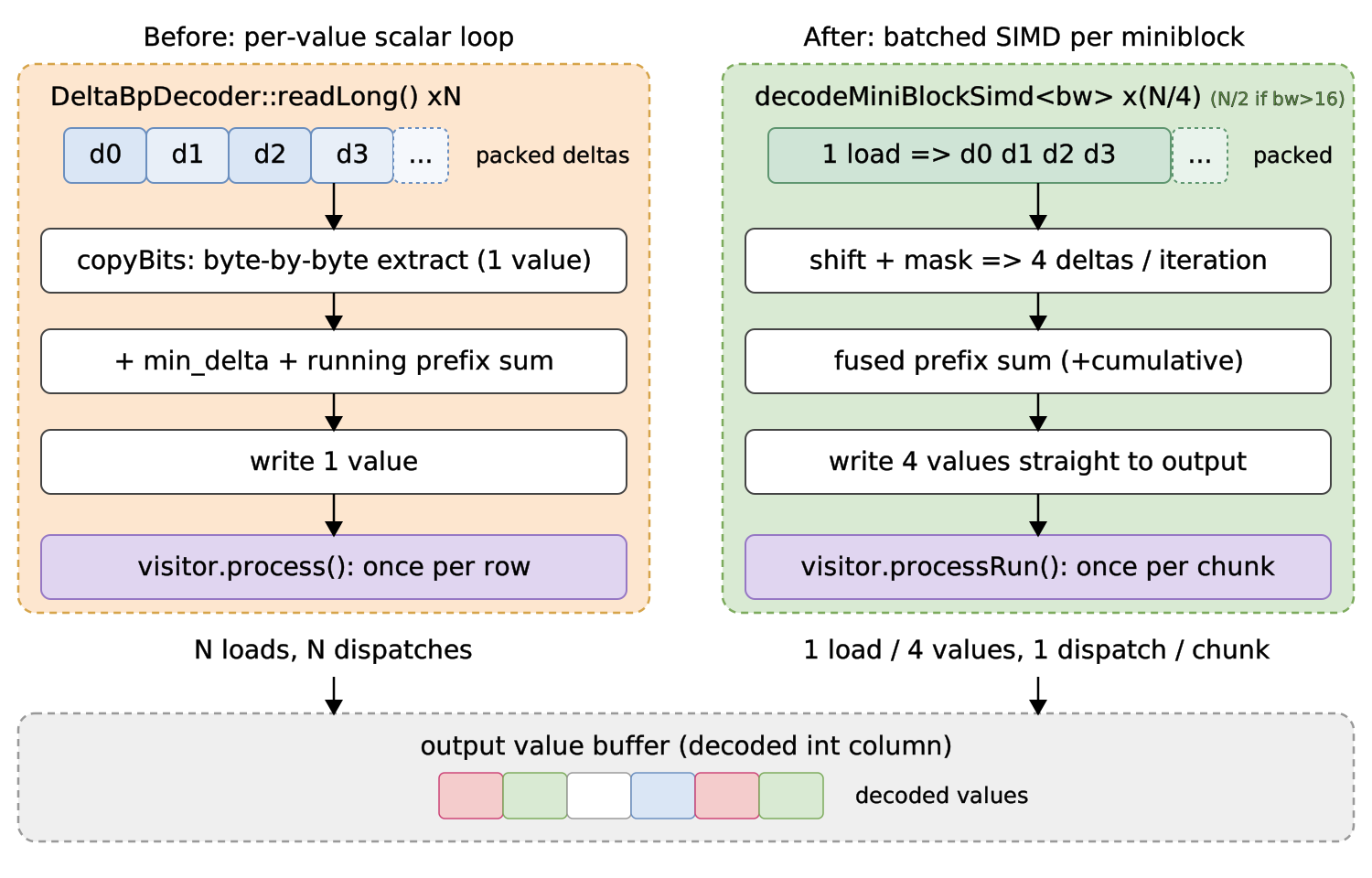
To address this performance disparity, two optimizations are contributed: first,
replacing a general-purpose bit-copy routine with a single unaligned memory
load, eliminating per-value function-call overhead; second, introducing a
batched decode path that leverages SIMD bit-unpack kernels to amortize
instruction costs across multiple values.
Together, these optimizations reduce Q12 scan CPU time from 5.0 s to 1.1 s
(a 4.5x improvement) and end-to-end wall-clock time from 1.71 s to 0.59 s
(a 2.9x speedup).
DELTA_BINARY_PACKED is Parquet's delta encoding for integers. Rather than
storing values, it stores the differences between consecutive values, then
bit-packs them. Because real integer columns are often sorted or slowly varying
(IDs, timestamps, dates, dictionary keys), the deltas are small and pack into
very few bits, so DELTA files are compact. The encoding is also reused
internally: DELTA_LENGTH_BYTE_ARRAY decodes string lengths through one delta
decoder, and DELTA_BYTE_ARRAY decodes prefix and suffix lengths through two,
so the integer decoder sits on the string read path too.
Velox's Parquet writer can opt into DELTA
(WriterOptions::encoding = arrow::Encoding::kDeltaBinaryPacked, off by
default). Re-encoding TPC-H lineitem as DELTA and running Q12 at SF10, the
lineitem scan that costs ~0.6 s of CPU on
PLAIN/dictionary data cost ~5.0 s on DELTA. Profiling pinned ~87% of the scan
CPU on DELTA decoding itself, making it the clear optimization target.
Following the profile: a general-purpose bit-copy
The profile pointed straight at DeltaBpDecoder::readLong, and specifically at
the call it used to extract each bit-packed delta:
bits::copyBits(
reinterpret_cast<constuint64_t*>(bufferStart_),
consumedBits,// source bit offset
reinterpret_cast<uint64_t*>(&value),
0,// destination bit offset, always 0
deltaBitWidth_);// at most 64
bits::copyBits is a fully general bit-range memmove: arbitrary source and
destination offsets, arbitrary length, looping byte by byte. The destination
offset is always 0 and the width is at most 64, so the call reduces to a single
unaligned 64-bit load and shift (bits::detail::loadBits), plus a low-bits
mask.
readLong runs once per value, so collapsing a byte-loop to one load yields a
significant improvement:
on its own it took Q12 scan CPU from 5.0 s to 2.8 s and wall time
1.71 s to 1.02 s.
The single-load fix improved throughput, but DELTA scan CPU was still ~4.5× the
PLAIN/dictionary baseline. Two costs remained: the bit-unpack still handled one
value at a time, and the read path called the column visitor's process() once
per row, paying per-row dispatch even when no filter was active. Both required
separate solutions.
Every value in a miniblock shares the same bit width, which makes the unpack a
tight, predictable loop, a natural SIMD target. The solution is
decodeMiniBlockSimd, a kernel templated on a compile-time bitWidth (shifts
and masks become constants) and dispatched at runtime by an index-sequence fold.
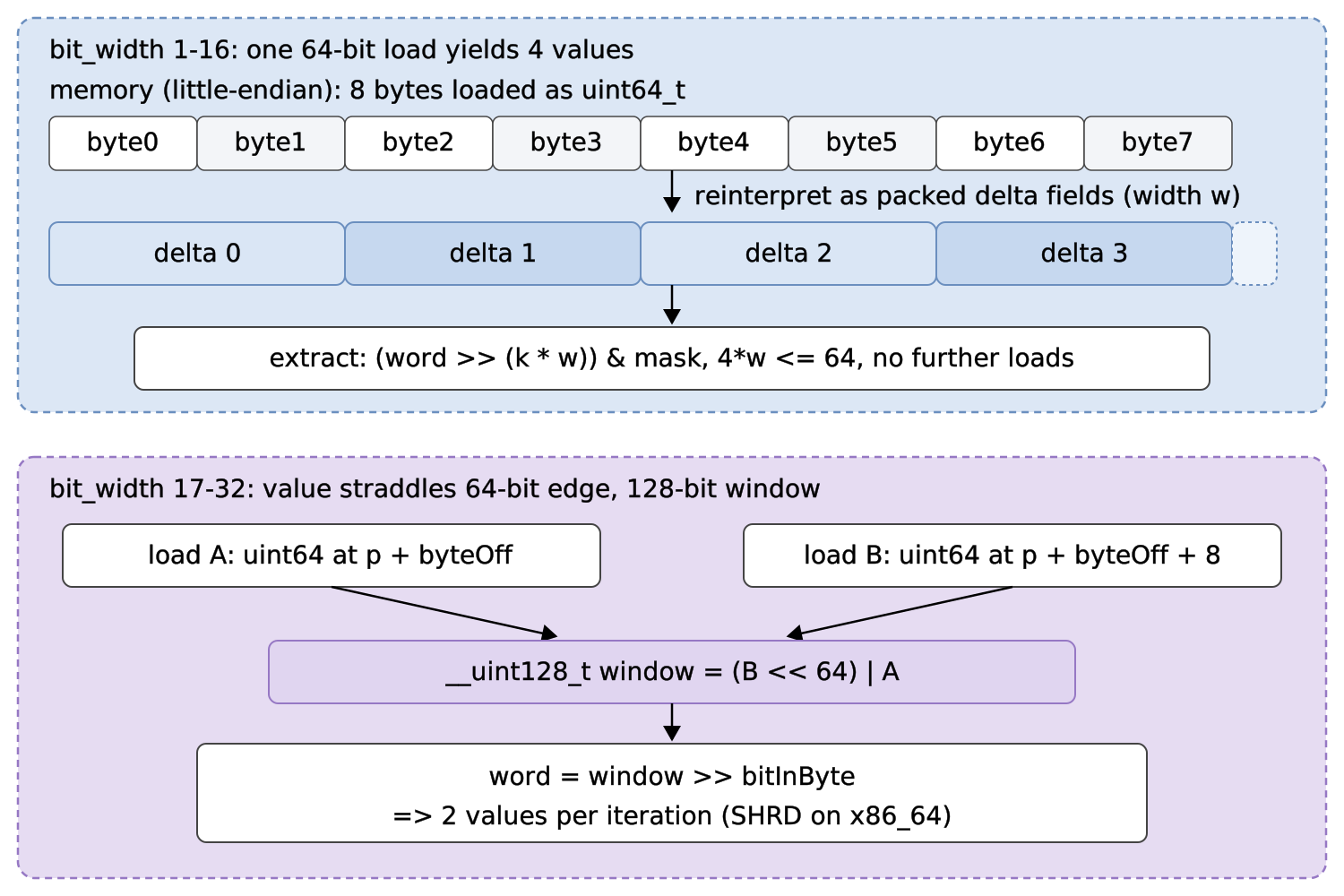
The strategy depends on the width:
bit width
strategy
0
constant-delta: prefix-sum of min_delta only, no loads
1–16
4 values per iteration from one unaligned 64-bit load (4 × bw ≤ 64)
17–32
2 values per iteration via a __uint128_t window (lowers to an SHRD funnel shift on x86_64)
33–64
scalar fallback (a single value can straddle > 64 bits after byte-misalignment; rare in practice)
The prefix sum is fused into the unpack: each kernel keeps a running
cumulative and writes finished values straight out, so there's no second pass
to turn deltas into values. Per the Parquet spec the arithmetic is unsigned mod
2⁶⁴, which makes overflow well-defined and lets the compiler vectorize freely.
For the dispatch cost, ColumnVisitor::processRun(), a bulk variant of
per-row process(), hands a decoded chunk to the visitor at once instead of
one row at a time. For unfiltered reads the decode writes straight into the
output with no per-row work; for filtered reads a deterministic comparison runs
in SIMD batches.
Sparse (filtered) reads decode a batch of 1024 values into a stack buffer and
index into it by row. DELTA's prefix-sum chain forces every physical value to
be decoded anyway (random-access to value N requires computing 0…N), so
one sequential, cache-friendly pass followed by array indexing outperforms
per-row seeking.
Profiling the DELTA_BYTE_ARRAY path surfaced three steady-state costs in
DeltaByteArrayDecoder, all removed:
Devirtualized readString() by removing the virtual base class.
Replaced make_unique child decoders (allocated per page) with
std::optional + reset(), eliminating per-page-boundary allocations.
Replaced the std::string "last value" with std::vector<char> + length,
dropping the std::string::_M_replace overhead (~6.5% of the string path)
from the prefix-share copy.
These improvements were measured on a DELTA_BYTE_ARRAY-encoded column and
are not reflected in the Q12 integer results below.
The first fix is a 1.7× wall improvement; the batched SIMD path reduces
wall time by another 42% and scan CPU by 60% on top. The DELTA-vs-PLAIN scan-CPU gap shrank
from ~8× to ~1.8×. The PLAIN/dictionary path was re-measured throughout and
stayed within noise; this work is confined to the DELTA decoders.
Let the profile pick the target. Comparing DELTA against the
PLAIN/dictionary scan on the same data made both the size of the gap and how
much was decoding unambiguous.
General-purpose primitives carry a tax.bits::copyBits is correct for
any offset and length; where the offset is 0 and the width ≤ 64 it collapses
to one load. Specializing the hot call site was the biggest win per line
changed.
Attack each layer of overhead separately. Batching the visitor call
removed per-row dispatch; SIMD kernels removed per-value unpack cost; fusing
the prefix sum into the unpack removed a whole pass.
Thanks to Masha Basmanova and
Ping Liu for the detailed reviews
that shaped the safety invariants and pushed for comprehensive bit-width test
coverage. In particular, Masha's early performance question on
#17633
directly motivated the SIMD batched decode work in
#17728
that brought the gap down to ~1.8x.
At Meta, features used for AI use cases are largely combined and stored within warehouse tables as map columns because frequent access to and manipulation of these features can scale poorly if modelled as top-level columns, which would result in extremely wide tables and frequent schema changes. Thus, to provide maximum flexibility, features are modeled as maps.
In a traditional columnar layout, map columns are typically represented in-memory by a few data streams. The diagram below illustrates an example dataset. Two main buffers or streams are allocated for map keys and values. Additional buffers are used for null flags and map offsets or lengths (note that map keys are non-nullable):
Analytical data lakes excel at full-table scans but struggle with point lookups. Key-value stores handle point lookups efficiently but cannot serve analytical queries. What if a single file format could serve both workloads?
Nimble's Cluster Index bridges this gap. It is a lightweight, hierarchical index structure embedded directly inside Nimble columnar files. It enables O(log n) point lookups and range scans on sorted data — without a separate index file, without an external service, and without sacrificing Nimble's columnar scan performance.
We have integrated the cluster index with Presto for analytical index joins and are actively integrating with ZippyDB for prefix key scans — both powered by the same underlying index structure, served through Velox.
We optimized two Unicode string helpers — cappedLengthUnicode and
cappedByteLengthUnicode — by replacing byte-by-byte utf8proc_char_length
calls with a SIMD-based scanning loop. The new implementation processes
register-width blocks at a time: pure-ASCII blocks skip in one step, while
mixed blocks use bitmask arithmetic to count character starts. Both helpers now
share a single parameterized template, eliminating code duplication.
On a comprehensive benchmark matrix covering string lengths from 4 to 1024
bytes and ASCII ratios from 0% to 100%, we measured 2–15× speedups across
most configurations, with no regressions on Unicode-heavy inputs. The
optimization benefits all callers of these helpers, including the Iceberg
truncate transform and various string functions.