Build Once, Probe Many: Hash Table Caching in Velox



TL;DR
Broadcast joins are common in analytical workloads because they avoid repartitioning both inputs when one side is small enough to replicate across workers. Compared with partitioned hash or sort-merge joins, they are often more efficient because the large probe side remains in place, avoiding its substantial network and storage shuffle cost.
In materialized execution engines such as Presto-on-Spark and Spark with
Gluten, build-side splits are planned for every join task. Without additional
coordination, each task reads the same data and constructs an identical hash
table. Velox's HashTableCache replaces this build-per-task behavior with a
build-once, reuse-many protocol within each worker process, delivering
significant cost savings for broadcast-join workloads by eliminating repeated
table construction and build-side I/O.
The build-side tax
Broadcast data follows a write-once, read-many I/O pattern. Every task that rebuilds the table must read the build side, compute hashes, populate a row container, and allocate a hash index. At large task counts, concurrent reads can overwhelm the storage or exchange service, leading to throttling and backoff. Tasks then stall while reserved worker resources remain idle.
The CPU cost is also significant when the broadcast side contains millions of rows or produces a hash table measured in gigabytes. Repeating the same work on every task wastes both compute and memory bandwidth.
Overall design
HashTableCache is a process-wide singleton that stores completed hash tables
and coordinates tasks attempting to build the same table. For Velox-managed
builds, entries are keyed by queryId:planNodeId unless the engine supplies an
explicit stable cache key. Exactly one task becomes the builder; concurrent
tasks wait for that build, and tasks arriving after completion reuse the table
immediately.
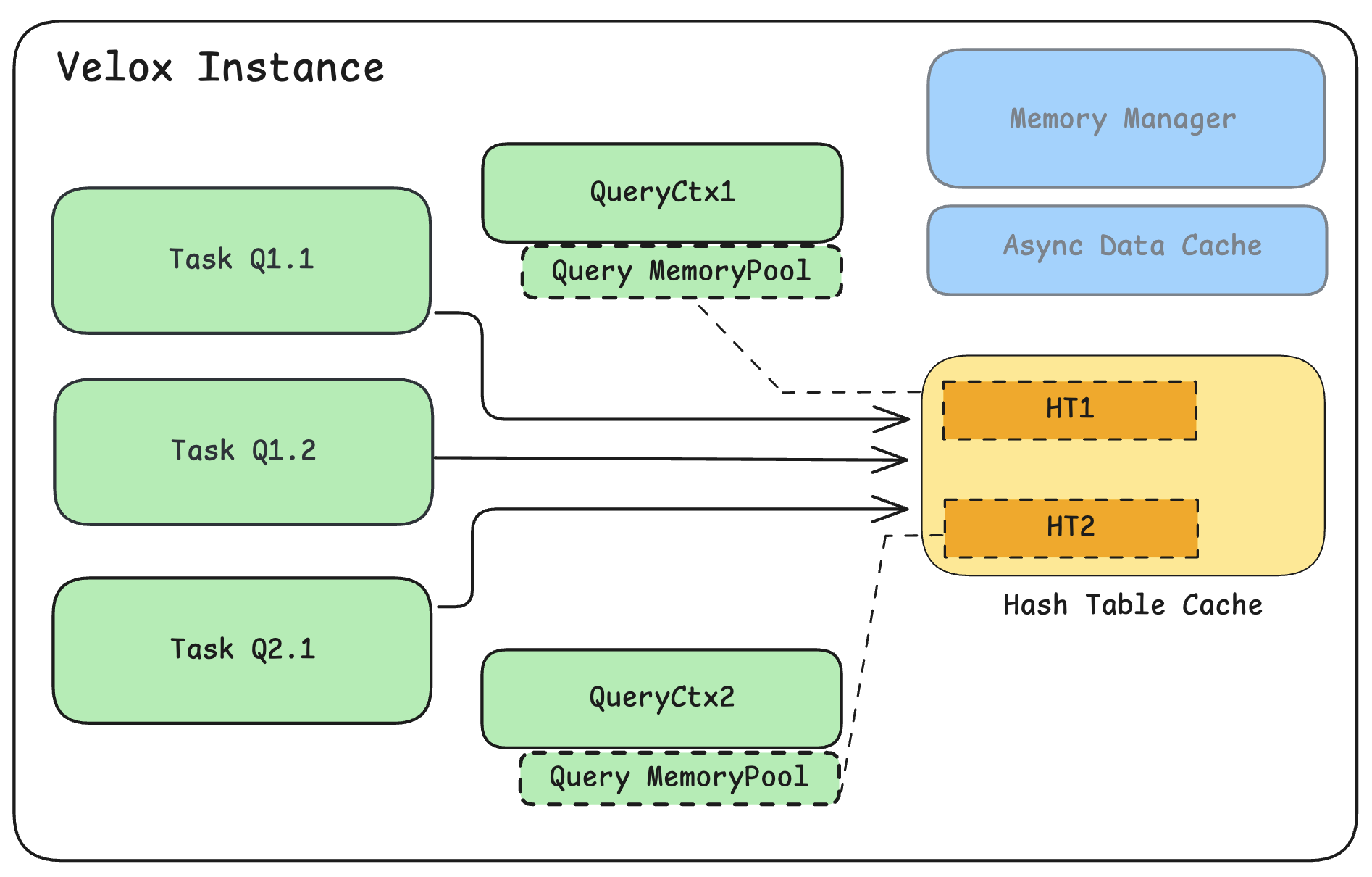
The design has three main components:
HashTableCache: Stores entries and serializes builder election, publication, and removal.HashTableCacheEntry: Holds the table, build-coordination state, and a dedicated memory pool.HashBuildintegration: Checks the cache during initialization, builds or waits, and publishes the completed table to both the cache and the local join bridge.
Cache structure
The singleton maps stable string keys to shared cache entries:
class HashTableCache {
 private:
  std::mutex lock_;
  std::unordered_map<
      std::string,
      std::shared_ptr<HashTableCacheEntry>> tables_;
};
Each entry contains the cached data and its coordination metadata:
| Field | Description |
|---|---|
cacheKey | Stable identifier used to look up the entry. |
builderTaskId | Task elected to build the table. |
tablePool | Query-scoped leaf pool used for table allocations. |
table | Completed BaseHashTable, null until publication. |
hasNullKeys | Whether the build side contained null join keys. |
buildComplete | Atomic flag indicating that the table is ready. |
buildPromises | Promises used to notify tasks waiting for the build. |
All cache-map decisions are made under one mutex. The lock protects only map lookups, insertions, removals, and promise creation; it is never held while reading input, allocating table memory, building the table, or waking waiters.
Cache API
Velox-managed builds use get(), put(), and drop(). The exist() and
add() methods support externally built tables, such as tables registered by
Gluten.
get()
Every cache-enabled HashBuild operator calls get() during initialization.
The method elects a builder or registers the caller as a waiter while holding
the cache mutex:
get(key, taskId, queryCtx, future):
    lock

    if key is absent:
        create incomplete entry
        set builderTaskId = taskId
        create query-scoped tablePool
        register QueryCtx cleanup callback
        return entry                         // builder

    if entry.buildComplete:
        return entry                         // late arrival

    if entry.builderTaskId == taskId:
        return entry                         // another builder driver

    create promise/future pair
    entry.buildPromises.push_back(promise)
    return entry and future                  // waiter
When creating an entry, get() adds tablePool as a leaf child of the query
pool. All drivers in the builder task allocate their partial tables from this
pool through HashBuild::tableMemoryPool(). The method also registers a
QueryCtx release callback that removes the cache entry when the query ends.
Drivers from the elected builder task do not wait on the cache. They continue
through the regular intra-task build path and coordinate with their peers via
HashJoinBridge.
put()
The last driver in the builder task merges the partial tables and calls
put() to publish the result:
put(key, table, hasNullKeys):
    lock
    assert entry exists and is incomplete
    entry.table = table
    entry.hasNullKeys = hasNullKeys
    entry.buildComplete = true
    promises = move(entry.buildPromises)
    unlock

    for each promise:
        promise.setValue()                   // wake outside the lock
Moving the promises out of the entry lets put() release the cache mutex
before fulfilling them. Resumed drivers and future callbacks therefore never
run while the global cache lock is held.
drop()
drop() removes an entry during query cleanup or when a builder abandons an
incomplete build:
drop(key):
    lock
    entry = move(tables[key])
    tables.erase(key)
    unlock

    promises = move(entry.buildPromises)
    entry.table.reset()                      // release outside the lock
    for each promise:
        promise.setValue()                   // unblock failed-build waiters
Table destruction and promise fulfillment occur outside the mutex. This keeps deallocation and scheduler activity out of the cache's critical section.
exist() and add()
External systems can check for and register already completed tables:
exist(key):
    lock
    return key exists and entry.buildComplete

add(key, table, hasNullKeys, tablePool):
    construct completed entry
    lock
    assert key does not exist
    tables[key] = entry
Unlike put(), add() does not complete an entry previously reserved by
get(). It creates a new completed entry, so duplicate keys are rejected.
Enabling hash table caching
Hash table caching is opt-in on HashJoinNode. Engines should enable it only
for broadcast joins whose probe path treats the shared table as immutable.
auto joinNode =
    core::HashJoinNode::Builder()
        .id(planNodeIdGenerator->next())
        .joinType(core::JoinType::kInner)
        .nullAware(false)
        .leftKeys({leftKeyField})
        .rightKeys({rightKeyField})
        .left(probeNode)
        .right(buildNode)
        .outputType(outputType)
        .useHashTableCache(true)
        .build();
When useHashTableCache is false, which is the default, the join follows the
regular build-per-task path.
End-to-end join execution
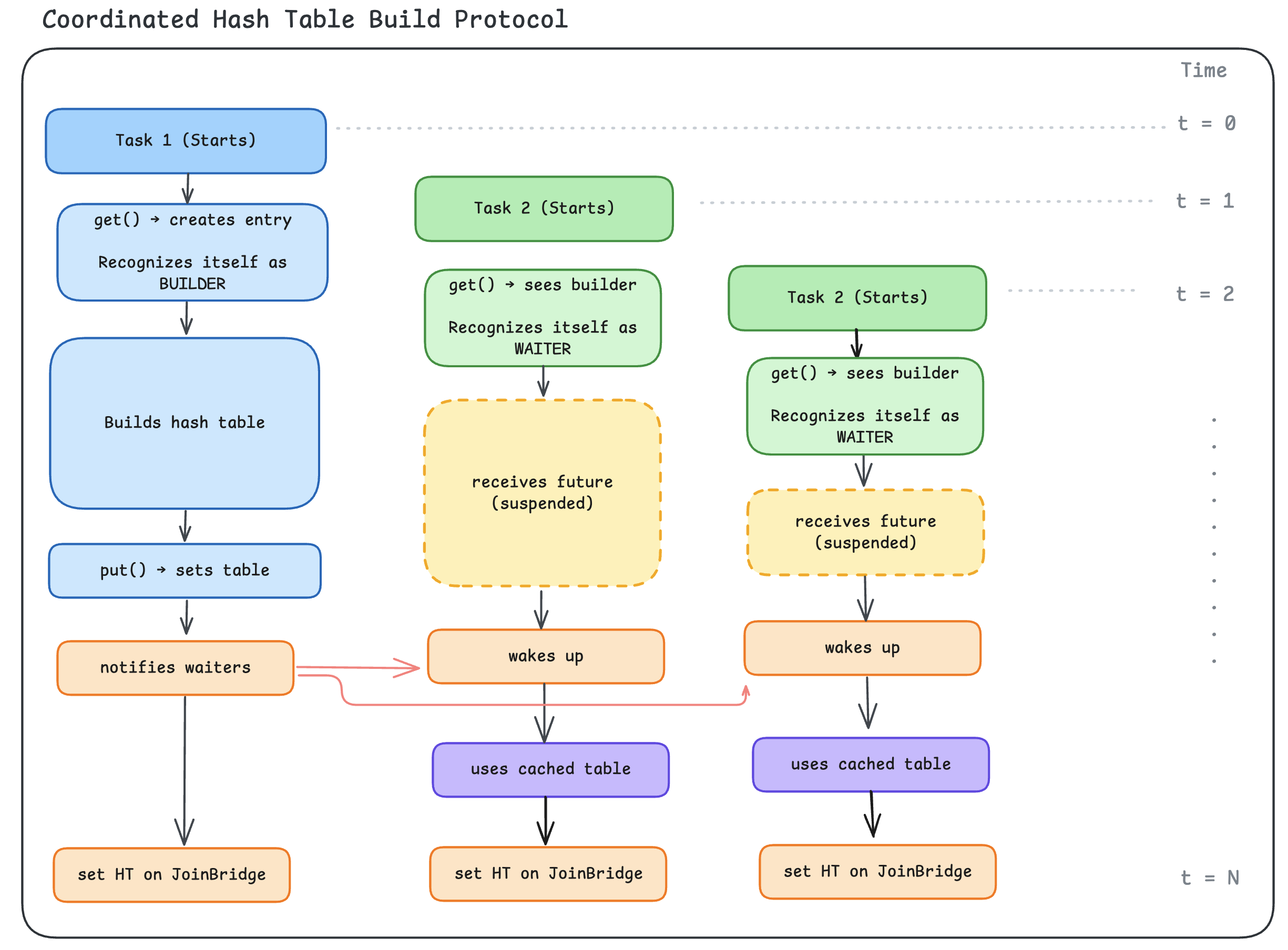
Join execution has three phases: build, synchronization, and probe. All
cache-specific coordination occurs during the build phase, where a task either
constructs, waits for, or retrieves the hash table. The synchronization and
probe phases continue through the existing HashJoinBridge and HashProbe
paths without a separate cache-specific implementation.
Step 1: Build or retrieve the table
For Velox-managed builds, each task takes one of three paths:
- Builder task: The first task to call
get()for a cache key becomes the builder. Every driver in that task builds its normal partial table. The drivers synchronize through the existingHashJoinBridgepeer coordination, and the last driver merges the partial tables before callingHashTableCache::put(). - Waiter task: A task that encounters an incomplete entry owned by another
task receives a
ContinueFuture, transitions tokWaitForBuild, and suspends until the builder callsput(). Once notified, it callsnoMoreInput(), retrieves the completed table, and passes it directly to its localHashJoinBridgewithout constructing a table. - Cache hit: A task arriving after
buildCompletebecomes true skips the wait and immediately passes the cached table to its join bridge.HashBuildreports these outcomes through thehashtable.cacheHitandhashtable.cacheMissruntime statistics.
Spark with Gluten follows a related external-build path:
- Spark constructs the build-side table during
BroadcastExchange, before probe-side joins run. - The driver serializes and broadcasts the table. Each executor deserializes
it as a native Velox object identified by a stable
buildHashTableId. - Gluten checks
exist()and, when necessary, callsadd()to register the completed table.
Step 2: Synchronize through HashJoinBridge
HashJoinBridge remains the handoff point between the build and probe sides of
each task. Whether the table was built locally or retrieved from the cache,
HashBuild calls joinBridge.setHashTable() to notify the probe operators
that the table is ready. The cache coordinates across tasks; the bridge
continues to coordinate within one task.
Step 3: Probe the shared table
HashProbe takes the table from its local bridge and executes normally. The
table is held by shared_ptr, so references in the cache, bridge, and active
probe operators keep it alive while it is being scanned. Reuse changes table
ownership and construction, not hash lookup semantics.
Memory ownership and lifetime
A cached table must outlive the task that built it because later tasks in the same query may reuse it. Allocating it from the builder operator's task pool would tie the table to a lifetime that ends too early.
Pool hierarchy
Query Pool
├── Task 1 Pool (builder may finish first)
│   └── Operator Pool
└── cached_table_<key> Pool
    └── Cached BaseHashTable and partial-table allocations
HashTableCache::get() creates tablePool as a thread-safe leaf child of the
query pool. All builder drivers allocate their partial tables from this shared
pool. The completed table therefore remains accounted to the query rather than
to any individual task and can survive builder-task completion.
Shared ownership
Without caching, the completed hash table can be transferred to
HashJoinBridge with unique ownership. With caching enabled, the entry retains
a shared_ptr<BaseHashTable> and passes a copy to the bridge. Probe operators
can hold their own references without preventing the cache from serving other
tasks.
Query cleanup
When get() creates an entry, it registers a release callback on QueryCtx.
Query teardown calls drop() before the query pool is destroyed. drop()
removes the entry under the mutex, then resets the table outside the lock. This
ordering releases cached allocations before their parent pool disappears and
avoids dangling pool references.
Failure recovery
The builder/waiter protocol requires an explicit failure path. If a builder
runs out of memory or otherwise closes before calling put(), an incomplete
entry with buildComplete == false must not remain in the process-wide cache.
Otherwise, every later task becomes a waiter on a future that no thread can
fulfill, effectively poisoning the cache key for that worker.
Recovery has two parts:
HashBuild::close()detects that the operator belongs to the builder task and that publication never completed, then callsHashTableCache::drop().drop()removes the incomplete entry and fulfills its pending promises outside the cache mutex.
Waking a waiter does not imply success. The waiter resumes in
receivedCachedHashTable(), observes that buildComplete is still false on
its retained entry, and fails with a diagnostic error rather than hanging.
Because the global entry has already been removed, a later retry can create a
fresh entry and become the new builder.
This distinction is important: a promise communicates that a wait condition
changed, not that the operation necessarily succeeded. buildComplete remains
the source of truth. Operational logging around builder election, waiting,
publication, wakeup, reuse, and failure helps distinguish normal cache misses
from waiters released after an abandoned build.
Failure cleanup should also validate the builder identity. If several drivers from a failed builder close concurrently, a stale driver must not remove a replacement entry created by a retry for the same key. Query-lifetime cleanup can remain unconditional, while failed-builder cleanup can supply the expected builder task ID.
Further optimization: Avoiding redundant source reads
Eliminating table construction is only part of the build-side savings. A waiter or cache-hit task must also avoid reading input that it will never use. This requires resolving the cache state before the driver pulls from the upstream scan or exchange.
Two mechanisms provide this behavior:
- Exchange-source initialization can be deferred until the driver determines that upstream output is required. This lazy path was introduced in Velox pull request #15768.
- A waiter enters
kWaitForBuild, while a cache hit completesHashBuildwithout requesting input. The driver checks the downstream operator's blocked state and input requirements before calling the upstream operator'sgetOutput().
As a result, waiter and late-arrival tasks do not fetch build-side splits or initiate exchange reads. They avoid both redundant hash-table construction and the associated storage and network I/O.
API evolution and integrations
The initial cache API centered on Velox-owned builds: get() reserves an entry
and put() completes it. The externally contributed
Velox pull request #17662
added add() and exist() so Gluten could inject a pre-built table while
preserving the original builder/waiter invariants.
The separation is deliberate. put() completes a reserved entry and wakes its
waiters; add() inserts a table that was already completed elsewhere. Both
paths produce the same cache-hit behavior for HashBuild, but their creation
and ownership contracts remain explicit.
Limitations and future work
Eviction
Cache eviction is not currently supported. Entries remain until query teardown
calls drop(). A memory-pressure-driven policy would need to address:
- Tracking memory held by cached tables.
- Selecting entries for eviction, for example by recency or size.
- Preserving active probes that still hold shared references.
- Providing a rebuild path for tasks arriving after eviction.
drop() already provides an entry-removal primitive, but eviction also needs a
clear contract with memory arbitration and active table consumers.
Spilling
Cached tables cannot currently spill. HashBuild::canSpill() and
HashBuild::canReclaim() return false when caching is enabled. Spilling clears
or reconstructs table state, which conflicts with sharing one stable table
across builder, waiter, and probe tasks.
Broadcast joins are generally selected only when the build side is expected to fit in memory. Larger inputs should use a partitioned join with spilling enabled. Spill-aware caching would need to define whether a table can be reclaimed while probe operators retain references and how later tasks recover or rebuild the evicted state.
Mutable hash tables
Cached tables are shared and must be treated as immutable. Some right-side join semantics record per-row probe state in the build table. Such paths cannot safely reuse one table across tasks. Engines enabling the cache must restrict it to compatible join types; library-level validation of these restrictions is an area for further hardening.
Conclusion
Broadcast joins are a substantial part of analytical workloads because they avoid shuffling the large probe side. Hash table caching makes these joins more efficient in materialized execution engines by changing broadcast-table construction from once per task to once per executor.
The process-wide cache elects one builder, suspends concurrent waiters, and
routes completed tables through each task's existing HashJoinBridge. Cache
state is resolved before upstream input is pulled, allowing reuse to eliminate
both repeated construction and unnecessary storage or exchange I/O. A
query-scoped pool and shared ownership allow the table to outlive its builder
task without escaping memory accounting.
Explicit abandoned-build recovery completes the coordination protocol: failed builders remove incomplete entries and wake waiters instead of leaving them blocked indefinitely. The external insertion API extends the same reuse path to engines such as Gluten while keeping externally built tables separate from Velox's builder/waiter contract.
Together, these mechanisms preserve the low-shuffle advantage of broadcast joins while reducing their CPU, memory-bandwidth, storage, and network costs.
Acknowledgements
Thanks to the Velox, Presto-on-Spark, and Gluten communities for the design, implementation, testing, and review that made hash table caching available across multiple materialized execution environments.