Slicing Encoded Streams Efficiently in Velox Nimble


Introduction
On serving paths, indexed reads such as prefix scans often need a small row range from a much larger stripe. Fetching the full stripe creates row-level over-fetch: it wastes network bandwidth in NIC-bound workloads, while decoding it into Velox vectors, selecting rows, and serializing again incurs significant CPU, allocation, and data-copy costs.
Nimble's
StreamSlicer
leverages white-box knowledge of each stream's encoding structure. It maps the
requested top-level row range to the corresponding range in each nested stream
and slices encoded bytes directly. For a compressed chunk, it decompresses the
chunk before applying encoding-level slicing.
This article explains how StreamSlicer maps nested row ranges and slices
encoded streams without decoding and re-encoding the full batch.
Nested stream mapping
For a flat scalar stream, [offset, offset + length) maps directly to encoded
positions. Nested streams require translation:
- For nullable data, count non-null bits before and within the requested row range. These counts define the offset and length in the values stream.
- For arrays and maps, sum lengths before and within the requested row range. The sums define the element-stream offset and length.
- For flat maps, count each key's set in-map bits before and within the requested row range. The counts define that key's value-stream offset and length.
StreamSlicer applies these translations recursively.
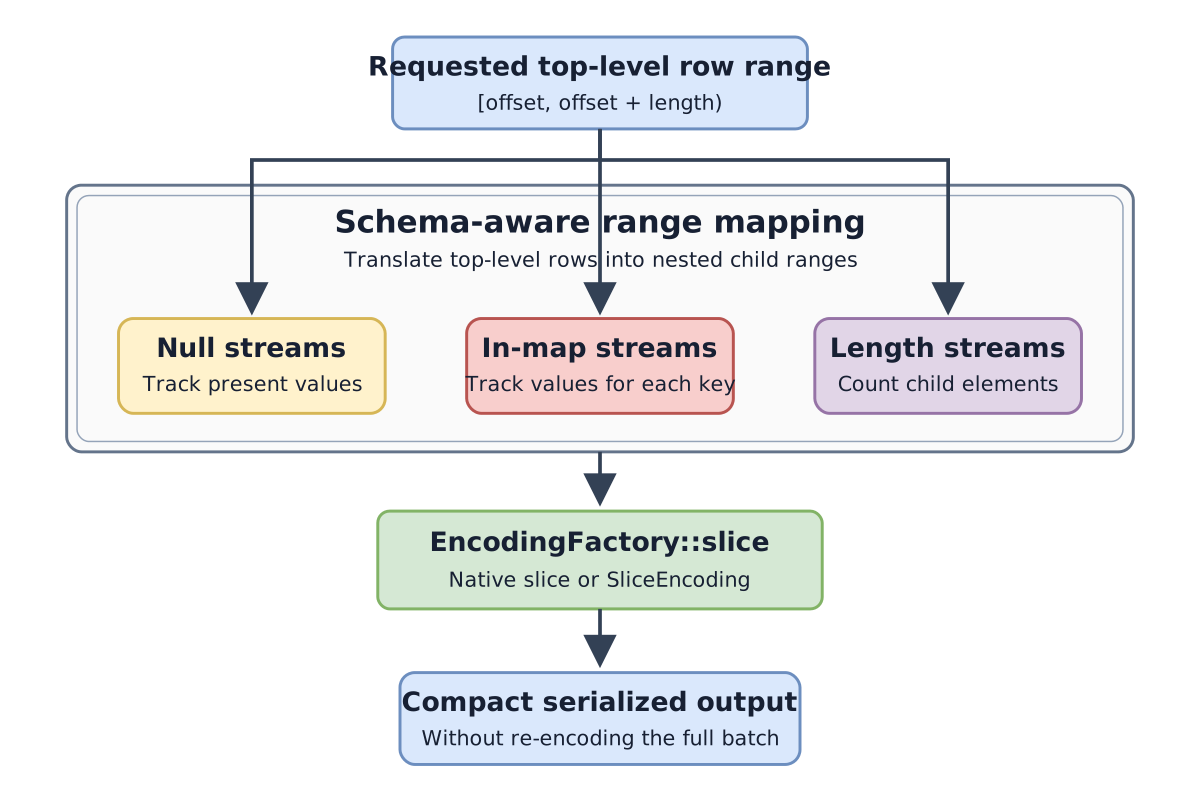
A top-level row range is translated into each nested stream's range before encoding-level slicing.
This avoids constructing a complete RowVector. If an encoding has no native
slice implementation, the fallback decodes only the requested values and
re-encodes them using the source encoding layout.
Slicing methods
Nimble supports four slicing methods:
| Method | What it does | When it applies |
|---|---|---|
| Full-range copy | Copies the original encoded stream | The request covers every row and the stream is self-contained |
| Native slice | Rewrites metadata and copies only the required encoded payload | The encoding has a format-aware slice implementation |
| Slice wrapper | Keeps complete structural units and records the requested sub-range in SliceEncoding | Trimming boundary units would require re-encoding |
| Re-encode fallback | Materializes the requested range and re-encodes it using the source layout | No native slice implementation is available |
Native slicing avoids the re-encode fallback. For example, FixedBitWidth copies packed bits while preserving its baseline and width; Dictionary preserves its alphabet and slices indices; nested encodings slice their children recursively.
Boolean range operations
Null and in-map metadata streams determine how top-level rows map to child
values. Nimble extends boolean decoders with range operations that extract a
bit range and count its set bits in one pass. StreamSlicer uses those counts
to retrieve child offsets and lengths without materializing or scanning the
metadata stream twice.
SliceEncoding supports two modes used below: row offset retains complete
runs or blocks, while value delta rebases encoded positions.
Row-offset mode: avoiding boundary re-encoding
RLE and BlockBitPacking are cheap to slice except when a range starts or ends inside a run or packed block. Trimming those units would require rewriting run lengths or unpacking and repacking boundary blocks.
The row-offset mode stores a logical view over complete structural units:
[slice prefix: logical row count]
[row offset into inner encoding]
[inner encoding bytes]
At read time, the wrapper skips the stored offset and stops at the logical length. RLE keeps complete touched runs; BlockBitPacking keeps complete touched blocks and rebases block offsets. This trades a small payload overhang and one decoder layer for avoiding boundary re-encoding.
Value-delta mode: rebasing encoded position streams
SparseBool stores the positions of true values, while PFOR stores the positions of exceptions. Neither has one entry per logical row. For example, a SparseBool stream can be represented as:
row:                0 1 2 3 4 5 6 7 8 9 10 ... 18
logical value:      F F T F F F F T F F  T ...  T
encoded positions: [2, 7, 10, 18]
For position stream [2, 7, 10, 18] and row range [6, 13), slicing
proceeds as follows:
- Find the first position at or after
6: zero-based slot1, which contains7. - Find the first position at or after
13: slot3, which contains18. EncodingFactory::sliceslices slots[1, 3), producing positions[7, 10].- Apply a delta of
-6, producing positions[1, 4]relative to the sliced row range.
EncodingView finds the two slot boundaries directly in the encoded
positions. Without a view, the fallback materializes the position stream once
to find them.
After slicing the position stream, the value-delta mode stores a delta that rebases positions relative to the requested range:
[slice prefix]
[inner row offset]
[value delta]
[inner encoding bytes]
SliceEncoding records this delta so readers interpret the sliced positions
relative to the new row range.
Reducing per-stream overhead
After removing most decode-and-re-encode work, smaller costs became visible:
StreamSlicerreuses Velox and encoding scratch pools.- Projected streams sharing physical bytes reuse stripped tablet chunks.
NimbleIndexProjectorfetches selected stream locations in one pass.- One output arena serves all partial stripes and transfers its chunks into the
returned
IOBufchain without copying the completed body.
The maxOverfetchRowsRatio option controls the tradeoff between network bytes
and slicing CPU. For each stripe, the projector computes the fraction of stripe
rows that were not requested. If this ratio exceeds the configured value, it
uses StreamSlicer; otherwise, it directly packs the full stripe. A value of
0.0 slices whenever avoidable row over-fetch exists, while 1.0 disables
slicing.
Summary
StreamSlicer addresses row-level over-fetch on serving paths by translating a
top-level range through nested metadata and slicing each encoded stream. Native
slices, boolean range utilities, SliceEncoding's row-offset and value-delta
modes, and buffer reuse minimize the CPU, temporary allocations, and copies
required to return the requested row range. This technique helps Meta's serving
workloads reduce network bandwidth consumption with minimal CPU cost.