Iceberg V3 in Velox




Iceberg V3 changes how row-level deletes are stored, gives every row a stable identity, and lets you add a column with a default value without rewriting data. Over the past six months we added most of this to the Velox Iceberg connector. Deletion vectors work on both read and write, including DELETE, UPDATE and MERGE. Row lineage, default values and the new geospatial types work on read, and write defaults work on write.
This post covers how each of those works, and a few places where the implementation was less obvious than the spec made it look.
| Feature | Read | Write |
|---|---|---|
| Deletion vectors | Yes | Yes |
| Row lineage | Yes | No |
| Default values | Yes (initial-default) | Yes (write-default) |
| geometry, geography | Yes (Parquet) | No |
| variant, timestamp_ns, multi-argument transforms, encryption | No | No |
Deletion vectors
In V2, a row-level delete is a file of (file_path, pos) pairs. Every DELETE,
UPDATE or MERGE adds more of these files. To scan one data file, a reader has
to open every delete file that might reference it, filter by path, and merge
the sorted positions. Until compaction catches up, the cost of reading a table
grows with the number of writes to it.
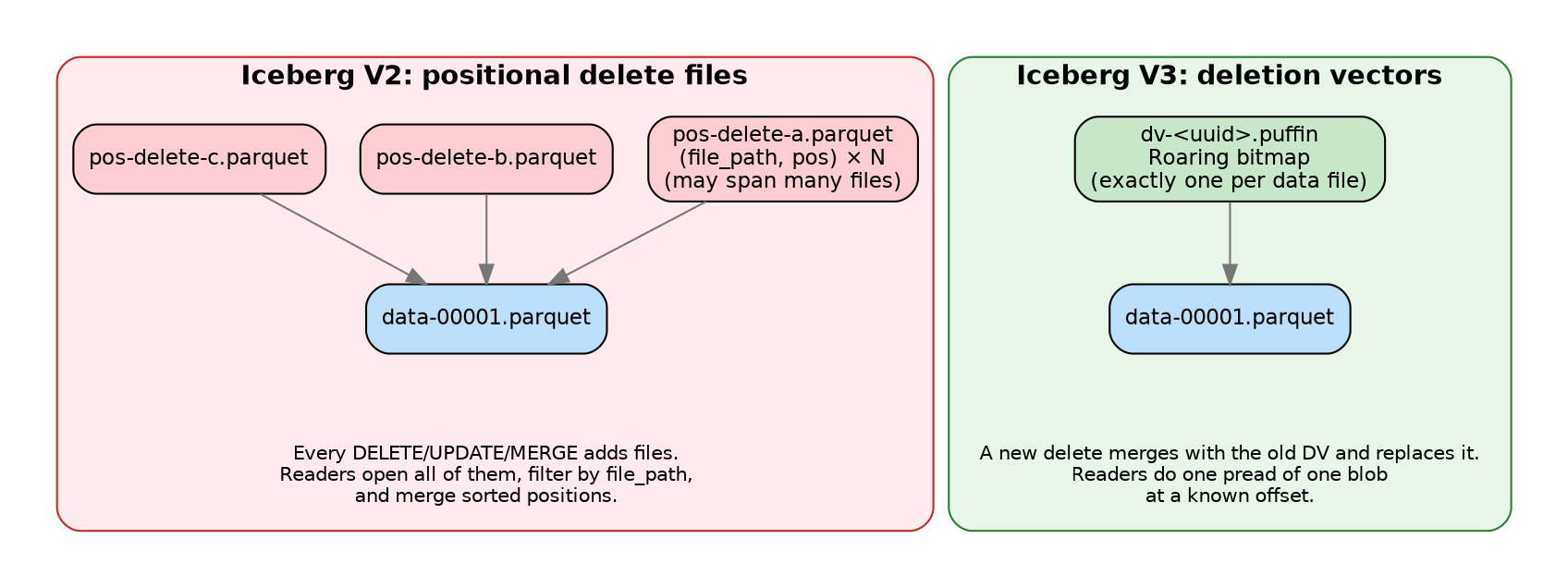
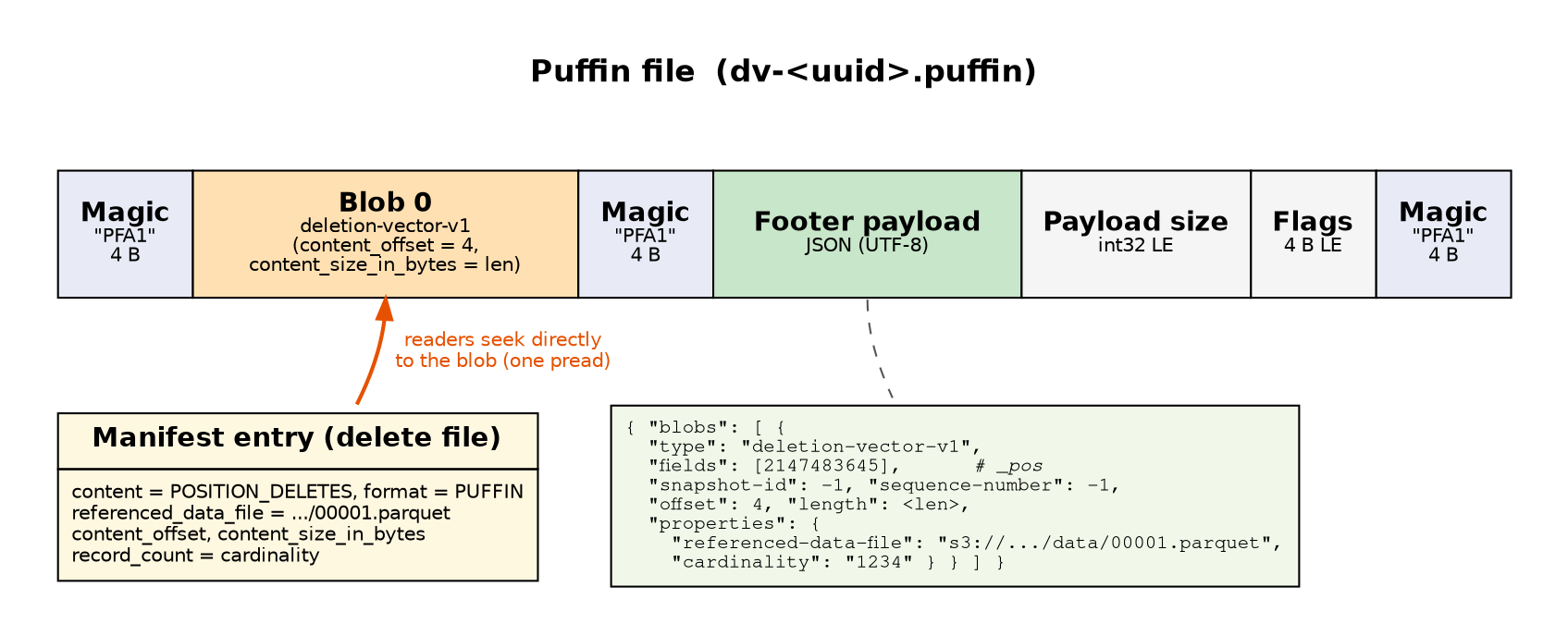
V3 replaces this with deletion vectors. A deletion vector is a Roaring bitmap
of deleted row positions, stored as a deletion-vector-v1 blob inside a Puffin
file. The spec allows at most one per data file. The manifest entry records the
blob's offset and length, so a reader makes one ranged read and never has to
parse the Puffin footer.
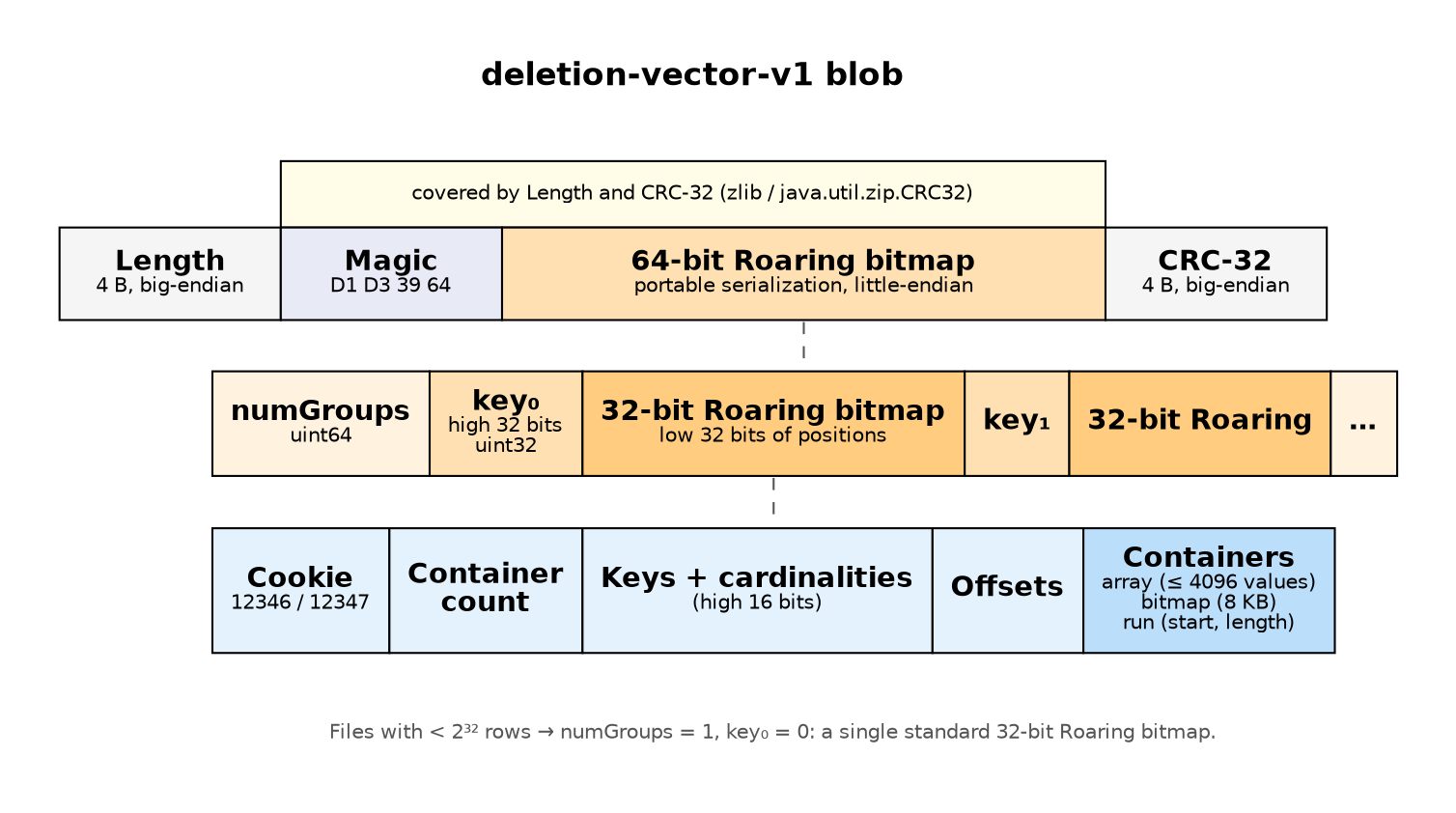
The blob wraps the bitmap in a big-endian length, a 4-byte magic number and a big-endian CRC-32. The bitmap uses the 64-bit portable Roaring format: a group count, then for each group a 32-bit key holding the high bits of the positions, followed by an ordinary 32-bit Roaring bitmap holding the low bits. A data file with fewer than 232 rows has exactly one group, so in practice this is the standard 32-bit format with a 12-byte prefix.
Reading
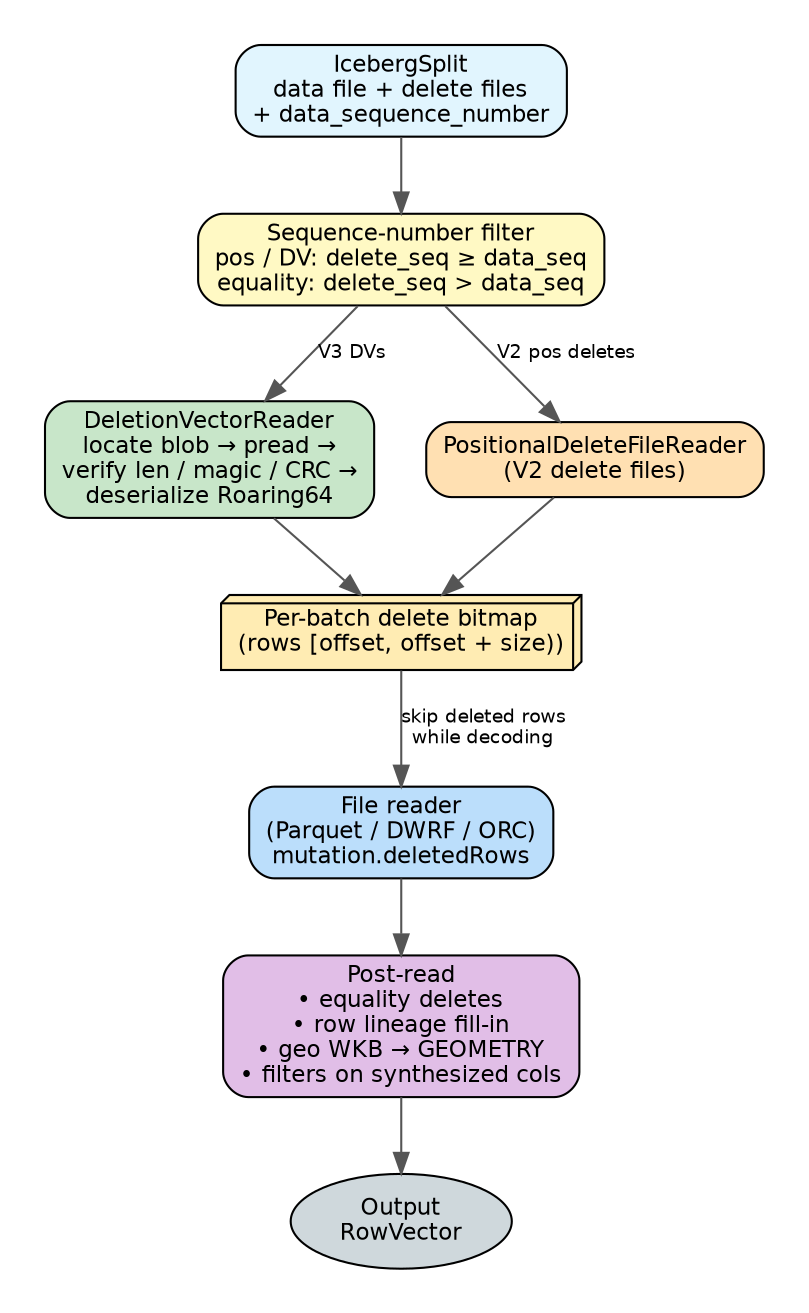
The main design question on the read side was where to apply the bitmap. We
could have decoded every row and filtered afterwards. But the Parquet and DWRF
readers already take a bitmap of rows to skip, and V2 positional deletes were
already using it. So DeletionVectorReader keeps the bitmap's containers
compressed, the way they are stored, and for each batch sets the bits of the
deleted rows in that batch's range straight from them. The file reader then
skips those rows while decoding. Our first version expanded every deleted row
into a sorted list of 64-bit positions instead. With half of a 1M-row file
deleted, that took about 5 ms to load; reading the compressed containers takes
about 0.04 ms.
V2 positional deletes write into the same bitmap. A table upgraded from V2 can have old delete files sitting next to new deletion vectors, and it needs no special handling: both feed the same bitmap before the batch is decoded. Equality deletes match on values rather than positions, so they stay on their own path after the read.
Sequence numbers decide which deletes apply to which data files, and the rule differs by delete type. A positional delete or deletion vector applies when its sequence number is greater than or equal to the data file's. An equality delete applies only when its sequence number is strictly greater. That asymmetry is what lets a single commit delete a key with an equality delete and insert it again.
We check the length, magic number and CRC before trusting a bitmap, and that each container is well formed. For example, array values must be in increasing order, because each batch binary-searches them. If a deletion vector is corrupt, the query should fail. It should not return rows that were deleted.
We went back and forth on one case. When a blob's referenced-data-file
doesn't match the path of the split being read, we log a warning and apply the
deletes anyway. Engines and catalogs don't all normalize paths the same way.
The manifest has already told us which data file this deletion vector belongs
to, and failing the query or dropping the deletes would both be worse than
trusting it.
Writing
The write side is harder because of the one-per-file rule. If a data file
already has a deletion vector, a new delete can't add a second one; it has to
replace it. IcebergDeletionVectorSink reads the existing deletion vector,
adds the new positions to it, and writes a new Puffin file next to the data
file. The commit message carries the referenced data file, the blob's offset
and length, the number of deleted rows (after removing duplicates: Iceberg
treats a deletion vector's cardinality as authoritative, and merging in the old
vector can repeat positions), and the data file's partition spec and partition
data. The coordinator then commits the new deletion vector in place of the old
one.
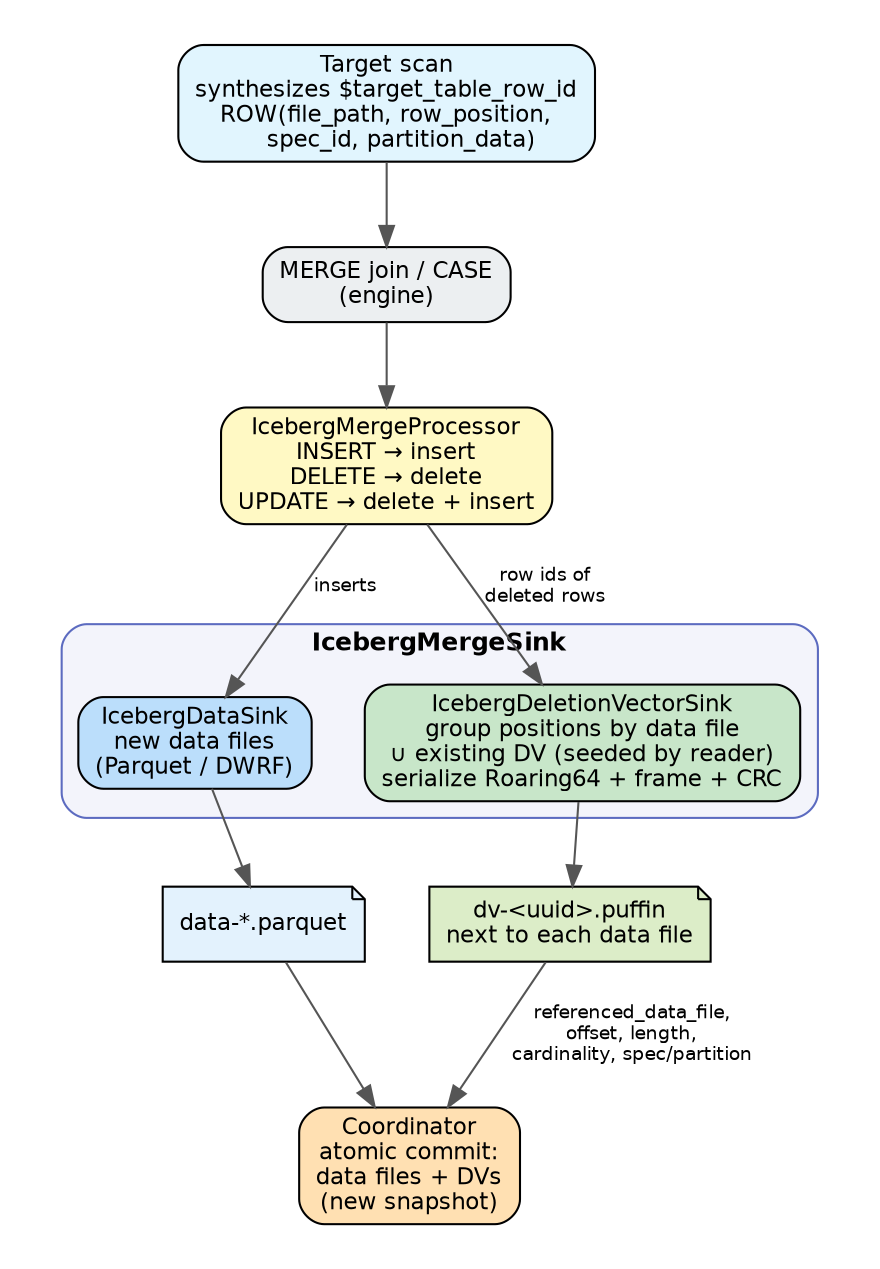
To build a deletion vector, the sink needs to know which file each deleted row
came from and where in that file it was. The scan adds a hidden
$target_table_row_id column,
ROW(file_path, row_position, spec_id, partition_data), in the same shape the
Presto Java connector uses. We got the partition fields wrong twice, and both
times the coordinator rejected the commit on a partitioned table. First, the
MERGE path copied only the file path and position out of the row ID, which
dropped the partition data. Second, the sink stamped every deletion vector with
the table's current spec ID, which is wrong for a data file written before the
spec evolved. The row ID is now passed through unchanged, and each deletion
vector is committed under its data file's own spec.
UPDATE and MERGE follow the same model as Presto's
DeleteAndInsertMergeProcessor. IcebergMergeProcessor turns each input row
into an insert, a delete, or both, since an UPDATE is a delete of the old row
plus an insert of the new one. IcebergMergeSink sends deletes to the deletion
vector sink and inserts to the normal data sink. It then returns both sets of
commit messages together, so new data files and new deletion vectors land in
the same snapshot. Because an UPDATE produces two rows, the changed-row count
has to count it only once. We got that wrong the first time too.
Matching Iceberg Java
Most of the time we spent on the writer went into matching Iceberg Java byte for byte, since in practice it is the reference implementation. Some examples:
- Our first CRC used
folly::crc32, which skips the final inversion that standard CRC-32 applies. Because the reader and writer used the same function, Velox-to-Velox round trips passed, and the bug only showed up when we read a deletion vector written by Spark. We now use zlib'scrc32, which matchesjava.util.zip.CRC32. - Java's
RoaringPositionBitmapstores the high 32-bit key as a signed int and caps it atInteger.MAX_VALUE - 1. We reject larger positions at write time so we never write a file Java can't read, and the reader enforces the same cap. Without it, a key of 231 or more would shift into the sign bit and produce a negative row position. - Java has no
"none"compression codec, so for an uncompressed blob the Puffin footer has to leave outcompression-codecentirely. - We write only array and bitmap containers, never run containers. The reader accepts all three, because other writers may use runs.
- We check this in CI. Eleven deletion vectors written by Iceberg Java 1.10 are checked in as test files, along with what Iceberg Java decodes from each, plus one bitmap in the older 32-bit format. They include run containers and positions on both sides of the 232 boundary, and the reader has to decode every one to exactly the same positions.
Row lineage
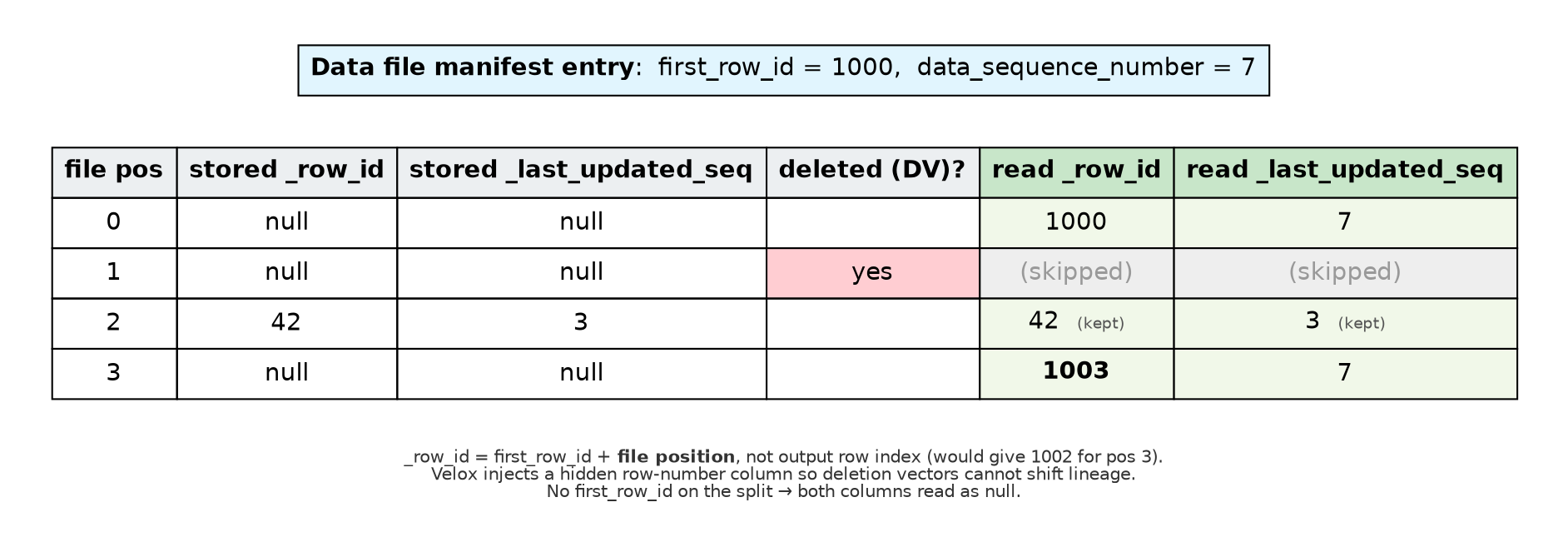
V3 gives every row a _row_id and a _last_updated_sequence_number. Writers
don't have to store them. When the stored value is null, the reader works it
out: _row_id is the data file's first_row_id plus the row's position in the
file, and _last_updated_sequence_number is the file's data sequence number. A
stored non-null value always wins, which is how a row keeps its identity after
compaction rewrites it. If the manifest entry has no first_row_id, which is
the case for files written before the upgrade to V3, both columns read as null.
The easy mistake is in "position in the file." Once a deletion vector removes
rows, a row's index in the output batch is no longer its position in the file.
Computing _row_id from the output index gives wrong IDs without any error. So
whenever lineage columns are projected, the reader adds a hidden row-number
column and computes _row_id from that.
Filters on lineage columns can't be pushed into the file reader, because it would evaluate them against the stored nulls. We turn off pushdown for those columns and apply the filter after the values have been filled in.
Default values
initial-default and write-default let you add a column with a default value
without rewriting the table. On read, a column that is missing from an older
file gets its initial-default instead of null, and filters on that column
still prune correctly. On write, if an INSERT leaves out a column that has a
write-default, IcebergDataSink fills in the default.
The write path has one guard worth mentioning. The sink only fills in a default when the column was actually left out of the INSERT, and it checks that every value it is about to replace is null. If the planner ever wrongly marks a column as omitted, the query fails rather than overwriting user data. Timestamp defaults are parsed as UTC, not session-local time. That was another bug we fixed along the way.
Geospatial types
V3 adds geometry and geography, stored as WKB. With VELOX_ENABLE_GEO on,
the connector reads Parquet GEOMETRY and GEOGRAPHY columns into Velox's
GEOMETRY and SPHERICAL_GEOGRAPHY types. The conversion happens in exactly
one place, the Iceberg connector. The Parquet reader returns plain VARBINARY,
and Hive tables never go through the conversion. That keeps WKB parsing out of
the generic readers and makes it impossible to convert the same value twice.
Before converting, we validate the WKB. We reject EWKB, Z and M coordinates,
truncated input, and nesting deeper than 100 levels. The GEOS version Velox
pins (3.10.7) doesn't limit recursion depth (newer releases do), so without
that check a crafted file could overflow the stack. Geography coordinates must
fall within [-180, 180] × [-90, 90], the same rule Presto's
to_spherical_geography applies. Velox and Presto Java share a golden file of
encoded geometries, so the two runtimes produce identical bytes.
Writing these types is rejected for now. Velox's internal encoding isn't WKB, and writing it as-is would produce files no other engine can read.
Benchmark
We ran a Velox micro-benchmark comparing deletion vectors with V2 positional deletes. It reads every row of one 1M-row, single-column DWRF file on local disk. The same deleted rows are stored three ways: one positional delete file, ten positional delete files, or one deletion vector. Each case ran five times, each time in its own process pinned to one core, and the times below are the medians. Reading the file with no deletes takes 19.6 ms.
| Read time | 1 positional file | 10 positional files | Deletion vector |
|---|---|---|---|
| 1% deleted | 22.8 ms | 23.4 ms | 22.9 ms |
| 5% deleted | 24.0 ms | 24.7 ms | 23.8 ms |
| 20% deleted | 27.1 ms | 27.6 ms | 26.0 ms |
| 50% deleted | 29.4 ms | 29.9 ms | 26.8 ms |
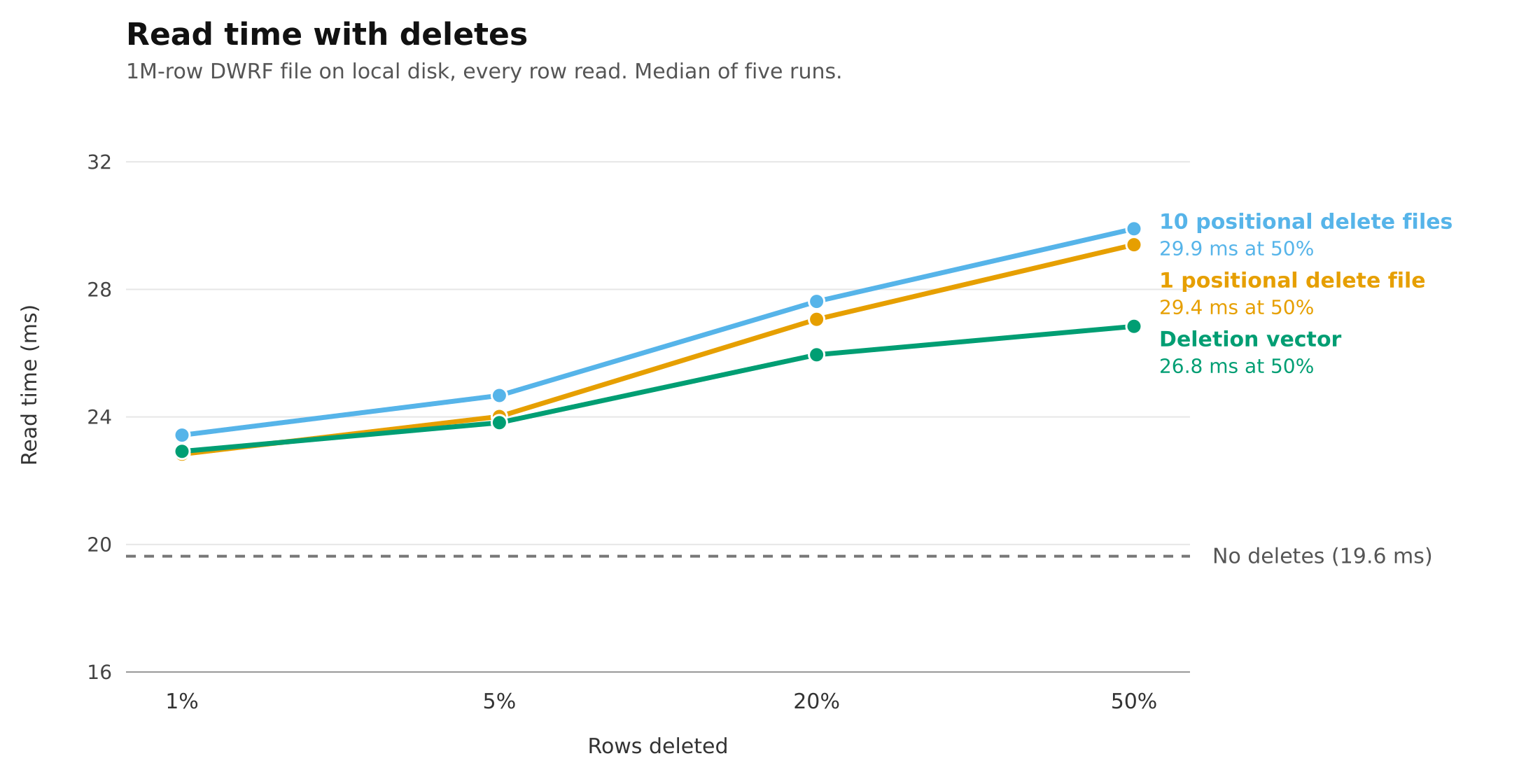
At 1% and 5% deleted, the deletion vector and one positional delete file were within 1% of each other. From there the deletion vector was faster: about 4% at 20% deleted and 9% at 50%. Ten positional delete files were about 2-3% slower than one at every rate.
Most of the time deletes add to the scan goes into handling the deleted rows, not into loading the deletes. Measured on its own, loading and applying the deletion vector takes about 0.03 ms at 1% deleted and 0.6 ms at 50%. A positional delete file has to be read and decoded like a small data file, and it grows with every deleted row.
| Delete file size | 1 positional file | 10 positional files | Deletion vector |
|---|---|---|---|
| 1% deleted | 30 KB | 39 KB | 20 KB |
| 5% deleted | 144 KB | 157 KB | 100 KB |
| 20% deleted | 524 KB | 597 KB | 130 KB |
| 50% deleted | 1,237 KB | 1,442 KB | 131 KB |
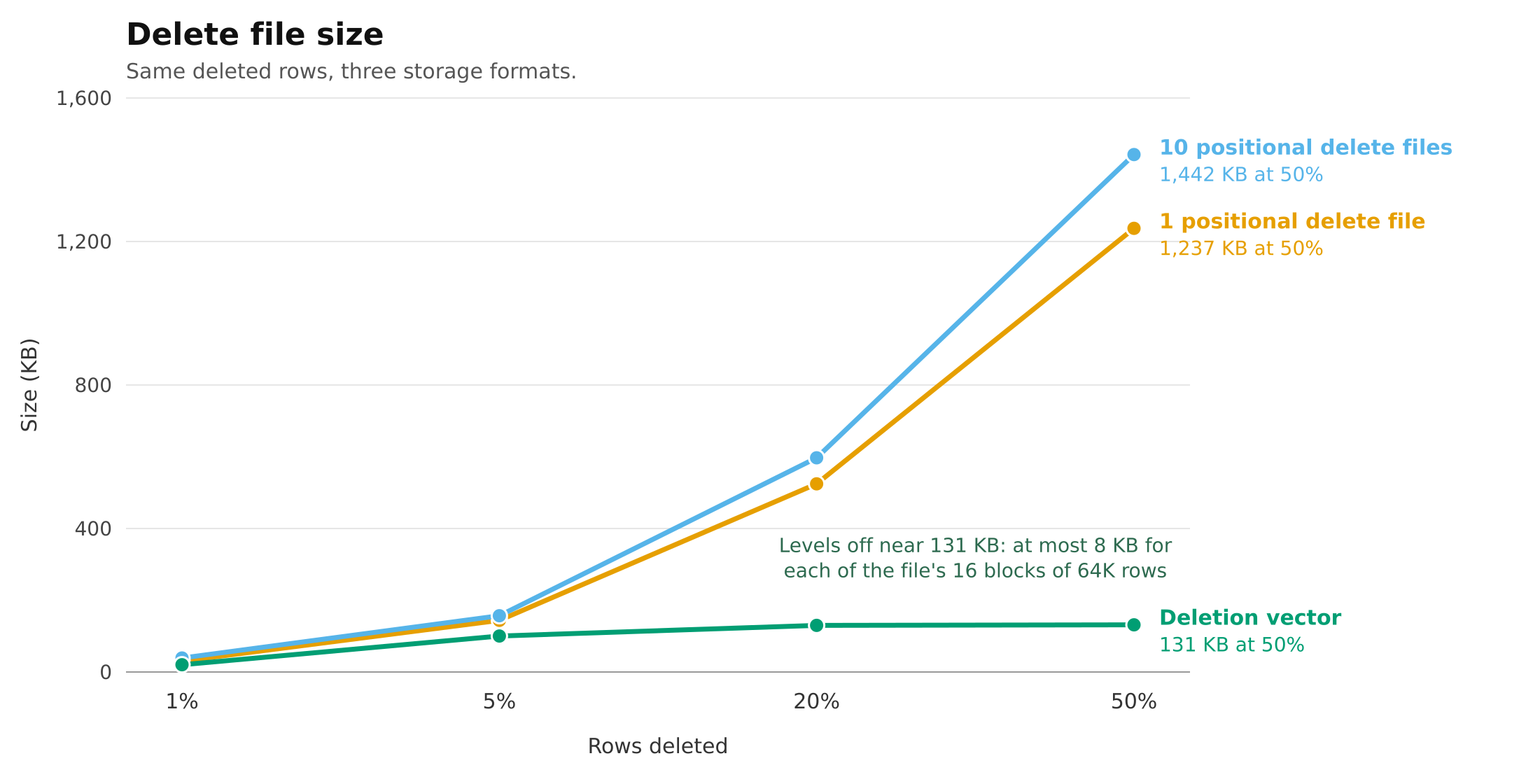
Deletion vectors were smaller at every rate, and the gap widens as more rows are deleted. At 50% deleted, the deletion vector was 131 KB against 1,237 KB for one positional delete file, about 9× smaller. It stops growing near 131 KB because a 1M-row file spans 16 blocks of 64K rows, and a block with many deletes is stored as an 8 KB bitmap however many of its rows are deleted.
These are local files, so the benchmark doesn't capture the cost of opening many small V2 delete files on remote storage, which is where accumulated deletes hurt most.
Compared with Iceberg Java
Since the bytes are the same on both sides, we can also compare Velox with
Iceberg Java 1.10 directly. We wrote the deletion vectors with Iceberg Java's
BitmapPositionDeleteIndex and checked that Velox writes byte-identical ones
for the same rows. Then, on the same machine, we timed loading one deletion
vector and checking every row of the 1M-row file against it. Each
implementation ran five times in its own process pinned to one core, on JDK 21
for Java, and the times below are the medians.
Iceberg Java can apply a deletion vector in two ways. Its forEach walks the
deleted positions once, which is the closest match to what Velox does.
isDeleted looks up one row at a time.
| Load and apply | Velox | Iceberg Java, forEach | Iceberg Java, isDeleted |
|---|---|---|---|
| 1% deleted | 30 µs | 131 µs | 20.1 ms |
| 5% deleted | 99 µs | 204 µs | 25.3 ms |
| 20% deleted | 288 µs | 582 µs | 13.6 ms |
| 50% deleted | 600 µs | 829 µs | 18.0 ms |
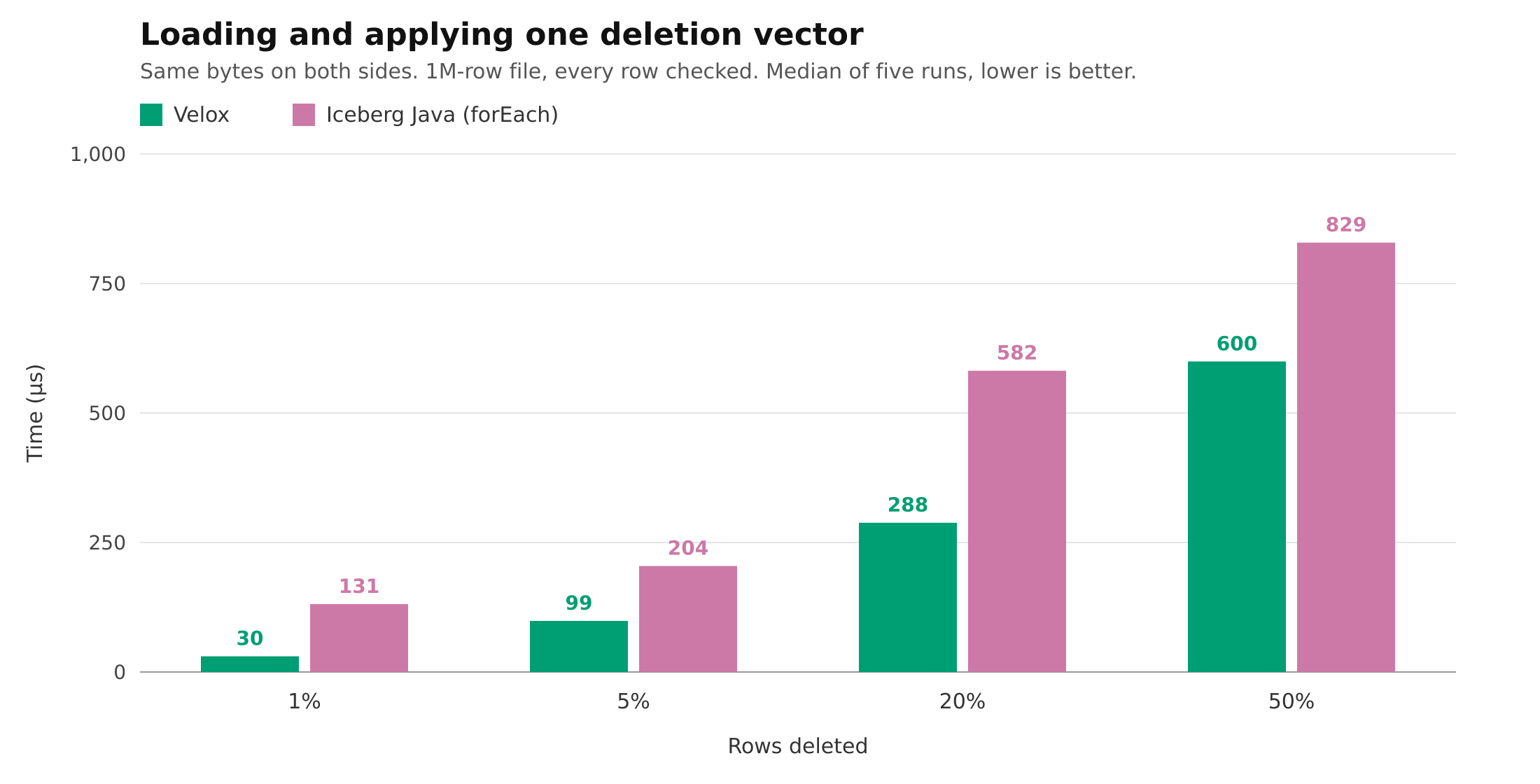
Velox was 1.4 to 4.3 times faster than Iceberg Java's forEach path, and the
gap is widest at low delete rates, where loading dominates. Velox checks the
blob and indexes its containers without building an in-memory bitmap, which
took 15 µs at 1% deleted, against 110 µs for Iceberg Java to read the blob and
build its bitmap. These numbers cover the deletion vector alone: in the Velox
scan above, loading and applying it is about 2% of the read time at 50%
deleted.
Building a deletion vector is the other half. For each data file that a DELETE, UPDATE or MERGE touches, the sink collects the deleted positions, serializes them, and counts the distinct positions for the commit message. For the first deletion vector of a data file the positions come from a scan in order, so the writer skips sorting and writes each Roaring container straight from its run of positions. When the data file already has a deletion vector, the sink seeds the writer with the old positions and then adds the new ones. The writer keeps track of the sorted prefix, sorts only the new positions, merges them in place, and reuses the result for the count.
We timed both cases the same way as above, with the same rows on both sides. For the merge case, every tenth deleted row is new.
| Build and serialize | First deletion vector: Velox | Iceberg Java | Merging into an existing one: Velox | Iceberg Java |
|---|---|---|---|---|
| 1% deleted | 43 µs | 237 µs | 50 µs | 371 µs |
| 5% deleted | 214 µs | 675 µs | 253 µs | 1.07 ms |
| 20% deleted | 1.00 ms | 1.73 ms | 1.17 ms | 2.02 ms |
| 50% deleted | 2.43 ms | 4.20 ms | 2.82 ms | 4.33 ms |
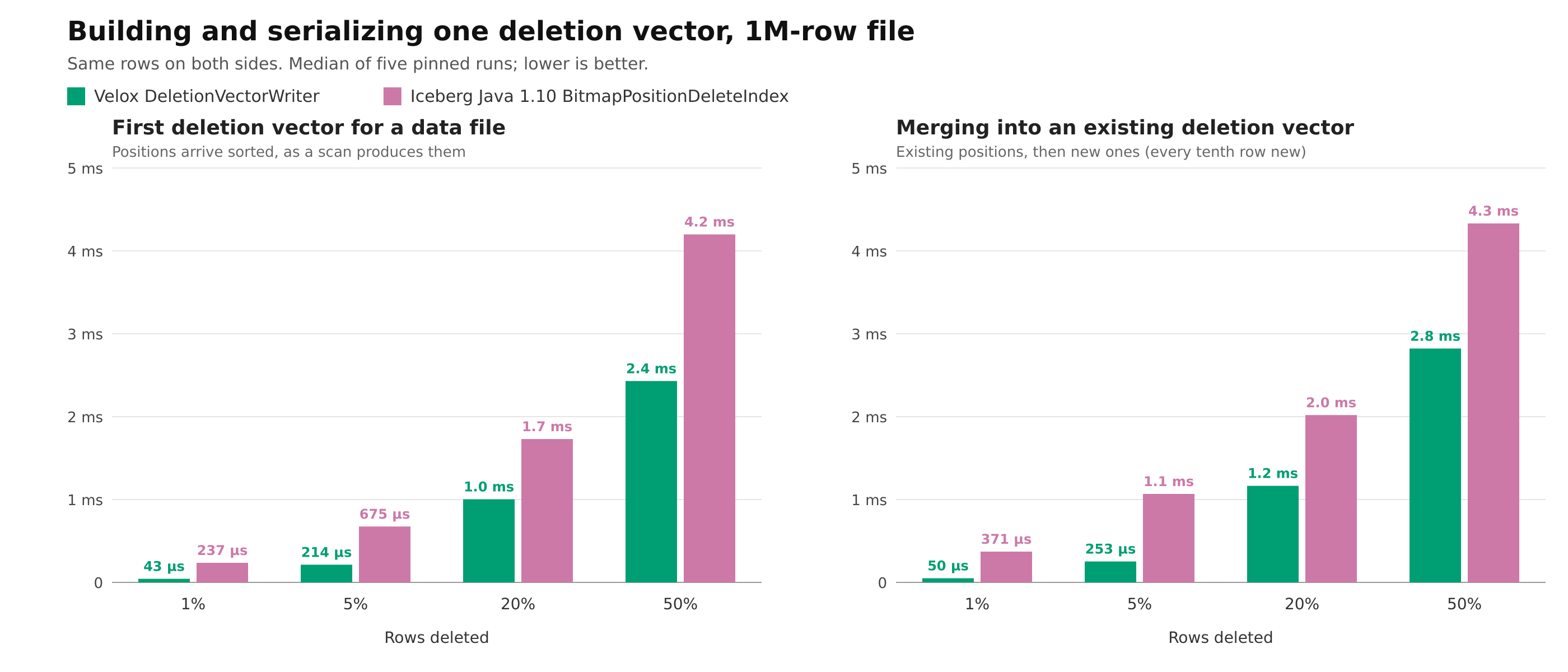
Velox was 1.7 to 5.5 times faster for the first deletion vector and 1.5 to 7.4 times faster when merging. Iceberg Java adds each position straight into its bitmap, so the order doesn't matter to it. New deletes that reach Velox in random order pay for a sort of the new positions, and there Velox is behind from 20% deleted up: 15.8 ms against 12.3 ms at 20%, and 41.5 ms against 20.4 ms at 50%. Building containers as positions arrive, the way Iceberg Java does, is the next thing to try. Iceberg Java's times also cover the blob's length, magic number and CRC, which take about 0.01 ms for a 131 KB bitmap, so they don't change the comparison.
What's left
Several parts of V3 aren't in Velox yet: the variant type, nanosecond
timestamps (timestamp_ns and timestamptz_ns), multi-argument transforms and
source-ids in partition specs, table encryption, and writing lineage columns
and geospatial types.
Thanks
This work was done by Apurva Kumar, Zhenyuan Zhao, Naveen Kumar Mahadevuni, Joe Abraham, Reetika Agrawal, Kevin Gu. Thanks also to the Iceberg community.