Hybrid FlatMap: Group-Level Feature Projection in Nimble


Introduction
Machine learning training data often stores features in wide maps. A single map column can hold thousands of feature IDs per row, while each model reads only a sparse subset of them. Different models read different subsets, and those subsets overlap. A serving layer that streams this data to trainers has to project the requested features out of every batch it returns.
Nimble's FlatMap layout, called Full FlatMap in this post, makes that projection precise by giving every key its own streams, but thousands of small streams add encoding, framing, and schema overhead that can be a large share of a small batch. Hybrid FlatMap partitions a map's keys into disjoint groups of features that are usually read together. All keys in a group share one set of streams, and the server projects each group on its own by passing its encoded streams through unchanged.
This article explains the Hybrid FlatMap layout and its two-stage projection, then compares it with Full FlatMap and regular maps in the Presto Page format.
The problem: wide maps, sparse and overlapping reads
A projection request names a map column and the feature IDs a model needs.
Full FlatMap gives every key its own inMap stream and value subtree, so the
server answers a request by forwarding the requested keys' encoded streams as
zero-copy slices.
On wide maps with small batches, that per-key layout has costs:
- Every key adds its own streams and schema entries, so encoding, framing, and schema overhead grow with the number of keys.
- Many small streams compress less effectively than fewer large ones.
- The server parses a schema with a separate stream subtree for every key when it projects a batch.
Hybrid FlatMap keeps the zero-copy projection of Full FlatMap and moves the projection unit from a single key to a group of keys. Compared with Full FlatMap, grouping features has three effects:
- Better encoding efficiency. Larger encoding units amortize per-stream encoding overhead and compress better.
- Less metadata. Keys in a group share streams, so a column carries fewer streams and schema entries. This matters most for small batches, where auxiliary metadata can be a large share of the payload.
- Cheaper projection. The server parses a smaller schema and forwards fewer streams per response.
The trade-off is coarser selection: a request transfers every key in each group it selects.
The Hybrid FlatMap layout
Hybrid FlatMap is a map encoding in the Nimble serializer. Callers enable it
per top-level MAP column through
SerializerOptions::hybridFlatMapColumns.
Each column is split into disjoint key groups:
- Configured groups list the keys that belong together, for example features that the same models usually request.
- The reserved Default group receives every key outside the configured groups.
Every group has its own keyPresence and key-major inMap streams and its
own value subtree, shared by all of its keys. The schema stores each group's
key list, groupKeys, once. Configured keys are stored in sorted string order,
and Default keys appear in the order the writer first sees them.
Within each group, this is a transposed map layout: values for the same key across rows are stored together. Clustering values for the same feature can improve encoding efficiency. With no configured groups, every key goes to the Default group. That single group still uses the transposed layout, but selecting it transfers the whole map.
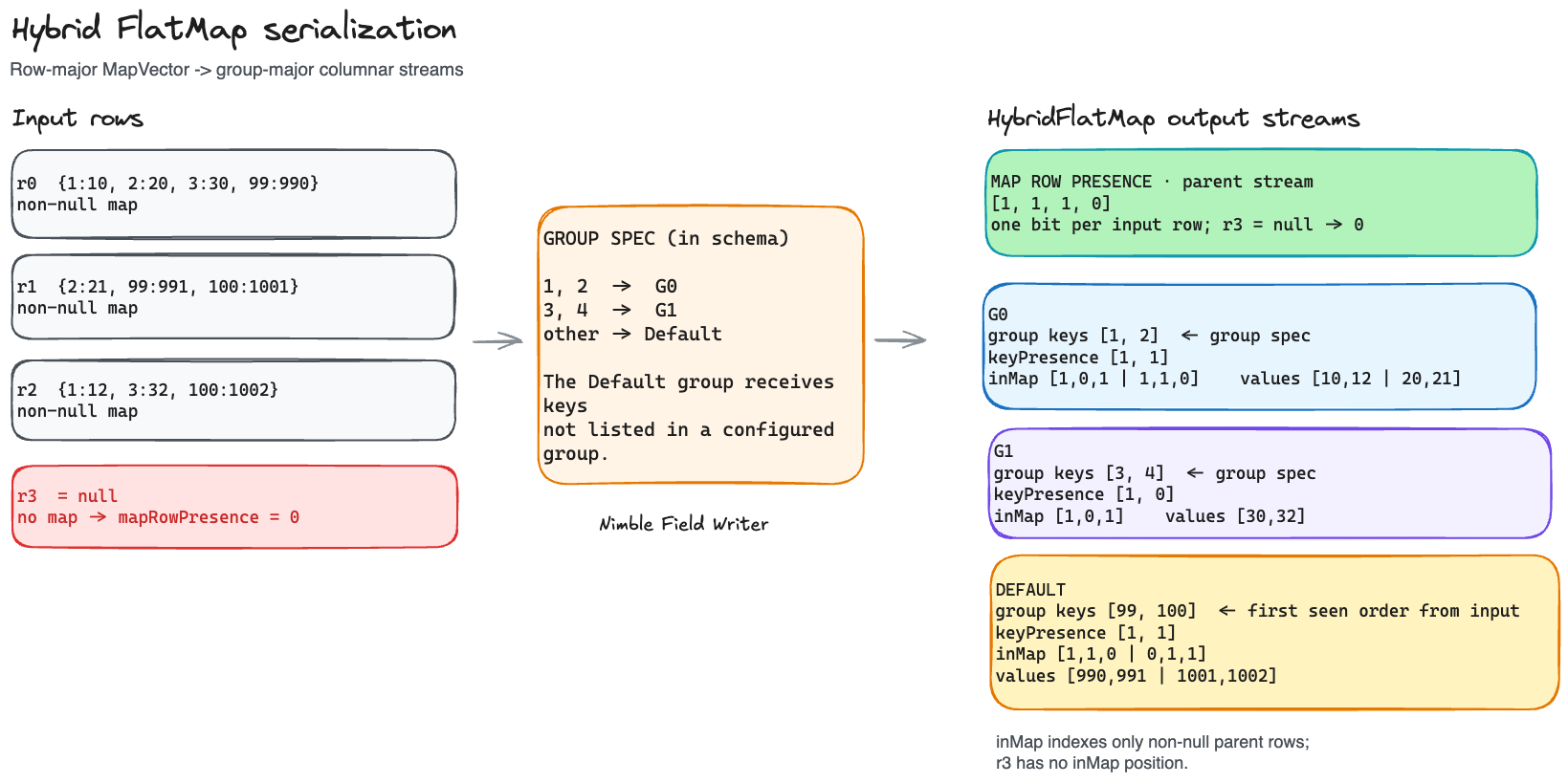
The writer turns row-major maps into group-major streams. Keys outside the configured groups go to the Default group.
Physical streams
- Map row presence: one bit per input row.
0means the whole map is null. Null rows appear only in this stream. The writer emits this stream only when the batch has a null map. keyPresence: one bit per group key.1means the key occurs somewhere in the batch.inMap: for each present key, one contiguous range of bits with one bit per non-null map row.- Values: dense values for the
1bits ininMap, in the same key-major order.
In the example above, key 4 is configured in G1 but absent from the batch,
so its keyPresence bit is 0 and it has no inMap range. A group writes
streams only when at least one of its keys is present in the batch. The writer
reorders values into key-major order through a dictionary view over the input
map, which reorders indices and leaves the values in place.
Two-stage projection
Projection is split between the server that stores the data and the client that decodes it.
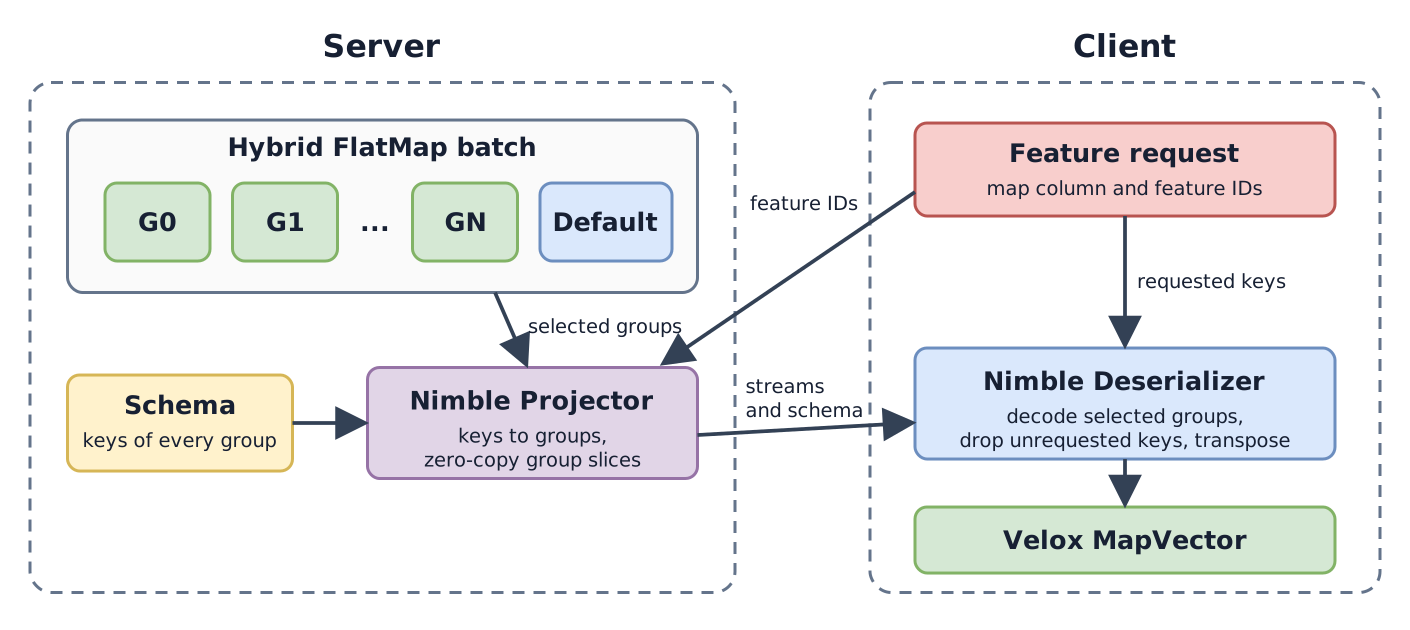
The server selects whole groups and forwards their encoded streams. The client decodes them and keeps only the requested keys.
Server: group projection
The
Projector
maps each requested key to its group using the serialized schema. The
serializer appends each new Default key to that schema, so a schema taken after
a batch is written lists every key the batch holds. The projector
binary-searches the sorted keys of configured groups and looks up Default keys
in a hash set. It then deduplicates the selected groups and adds their encoded
stream ranges to the response as zero-copy slices, leaving every value encoded.
A requested key that the schema lists selects its group, even when the batch
holds no value for it. In the example, a request for the absent key 4 would
select G1, because G1 lists key 4. The projector selects groups only for
keys that the schema lists, which include every key the batch holds. When all
of a column's requested keys are outside the schema, the column projects as a
Default group with an empty key list and no streams. It decodes as empty maps,
and null rows stay null.
The projected schema keeps only the selected groups and renumbers their streams from zero, so the client decodes responses with the projected schema alone.
Client: exact-key filtering
A selected group can hold companion keys: keys outside the request that share
the group with a requested key. The client passes the same feature IDs to the
deserializer as map-key subfields, such as features[2]. The deserializer
then decodes each group that holds a requested key and drops the companion
keys. It transposes the remaining key-major data into row-major order to build
a Velox MapVector. A client that omits key subfields gets every key in the
response.
Using the example above, a request for keys 2 and 99 works as follows:
- Server group projection keeps map row presence and drops
G1. It keepsG0(keys1and2) and the Default group (keys99and100) whole, so companion keys1and100stay in the response. - Client exact-key filtering keeps keys
2and99and removes1and100. The server already prunedG1, so the client receives and decodes onlyG0and the Default group.
| Row | Original map | After server projection | After client filtering |
|---|---|---|---|
r0 | {1:10, 2:20, 3:30, 99:990} | {1:10, 2:20, 99:990} | {2:20, 99:990} |
r1 | {2:21, 99:991, 100:1001} | {2:21, 99:991, 100:1001} | {2:21, 99:991} |
r2 | {1:12, 3:32, 100:1002} | {1:12, 100:1002} | {} |
r3 | null | null | null |
Trade-offs and current limits
- A group is the smallest projection unit. Requesting one key transfers and decodes the rest of its group before the client filters it out, so the grouping should follow how keys are read together.
- Hybrid FlatMap supports top-level
MAPcolumns with signed integer or string keys. It is available only in the Nimble serializer. - Values are key-major within a batch, so the reader decodes each batch that contains a Hybrid FlatMap column separately. The serializer sets a flag in the batch that tells the reader to do so.
- Projection selects whole values: a subfield that reaches into a value, such
as
features[2].x, is rejected. Full FlatMap columns can be read as structs; Hybrid FlatMap columns are read as maps. StreamSlicercannot yet row-slice Hybrid FlatMap streams.
Results
We compared Full FlatMap, Hybrid FlatMap, and regular maps in the Presto Page format on the same data and projection requests. The Hybrid FlatMap run used configured groups plus Default.
The benchmark used:
- Eight feature datasets from a snapshot of production training data.
- The first 20 batches of each dataset.
- 109 saved projection requests, weighted by how often readers issue them.
For the Nimble layouts, storage and projection sizes include the serialized schema. Projection size includes any companion keys that the client later filters out. Within each dataset, projection size and CPU time are activity-weighted means over that dataset's requests.
For each metric and baseline, we divide Hybrid FlatMap's measurement by the
baseline's measurement for each dataset to get ratios r_1 through r_8. We
then report their geometric mean: (r_1 * r_2 * ... * r_8)^(1/8). Each dataset
has equal weight, regardless of its size or number of requests. For example,
ratios of 2x and 0.5x have a geometric mean of 1x. A ratio of totals would give
datasets with larger baseline measurements more influence.
Every projection was validated against the expected decoded output. The benchmark runs in one process and excludes network transfer and cache lookups. For Presto Pages, the server decompresses and deserializes the page, keeps the exact requested columns and keys, then serializes and compresses the result. For both FlatMap layouts, the server forwards selected encoded streams and the client decodes them. Server CPU measures the transformation needed to prepare a response. When transformed responses are cached, that work is paid on cache fill; client decoding into Velox vectors is paid on every read.
The ratios below are rounded geometric means of Hybrid FlatMap / baseline.
Lower is better for all four metrics.
| Metric | vs. Full FlatMap | vs. Regular maps (Presto Page) |
|---|---|---|
| Storage size | 0.64x | 1.05x |
| Projection size | 0.76x | 1.10x |
| Server CPU time | 0.39x | 0.016x |
| Client CPU time | 1.01x | 2.17x |
Compared with Full FlatMap:
- Storage size and projection size. Shared group streams cut encoding and metadata overhead, which outweighs the companion keys that whole groups carry.
- Server CPU time. The server parses a smaller schema, because Full FlatMap keeps a separate stream subtree for every key while Hybrid FlatMap keeps one per group. It also forwards fewer streams per response.
- Client CPU time. The client decodes whole groups, then drops companion keys and transposes key-major data. That work costs about as much as decoding Full FlatMap's per-key streams.
Results vary by dataset. On some datasets, Hybrid FlatMap had a larger projection size, more server CPU time, or more client CPU time than Full FlatMap. The outcome depends on how well the groups match the requests.
Compared with regular maps in Presto Pages, Hybrid FlatMap used about 5% more storage and produced about 10% larger projection payloads, while reducing server CPU time by about 98%. Client CPU time was about 2.17x as high. Presto Pages remove unrequested keys on the server; Hybrid FlatMap transfers whole groups and filters companion keys while decoding on the client.
These measurements compare the configured Hybrid FlatMap groups with the Presto Page format, including their encoding, compression, and projection paths. They do not isolate the effect of transposing map entries. A comparison with all keys in a single Default group would remove the effect of pruning configured groups; that configuration was not measured here.
Summary
Hybrid FlatMap serves sparse, overlapping feature requests from wide maps by projecting groups of keys that are read together. Compared with Full FlatMap, grouping lowers storage size, projection size, and server CPU time. Client CPU time stays about the same. Compared with regular maps in Presto Pages, it uses slightly more storage and projection bytes, much less server CPU time, and more client CPU time. Within each group, values are clustered by key across rows. The server forwards the selected groups' encoded streams as zero-copy slices. A client that passes the requested keys to the deserializer filters exact keys while decoding. The cost is coarser selection, so the grouping should follow how keys are read together.